Finding an Online Course Topic: How to Identify a Profitable Niche
URL Slug: /blog/find-an-online-course-topic
Meta Description: Finding an Online Course Topic in 2026: The Niche Triangle, the Top 15 Niches in the DACH Market, and a Validated 4-Step Process for Your Profitable Course Idea.
Answer Capsule: A profitable course niche in 2026 must meet three conditions: you must have credible expertise, there must be measurable demand, and the niche must be AI-resistant. The niche triangle—expertise × demand × AI resistance—is the validation framework that prevents you from spending months producing a course that nobody buys.
48.7% of all creators earn less than $10,000 a year — according to Influencer Marketing Factory 2026. The most common reason for this income isn't a lack of talent or poor production quality. It's choosing the wrong niche.
A course that solves the wrong problem won’t sell—no matter how well it’s produced or how much passion you put into it. Choosing the right niche is the decision that determines everything else: how easily you’ll find customers, how much you can charge, and whether your business will still be around in three years.
On top of that, a new variable will emerge in 2026: AI. ChatGPT, Claude, and others provide general knowledge for free and in a matter of seconds. Anyone who chooses a niche that competes directly with them is up against a free, infinitely scalable service. That’s a battle you can’t win.
This guide provides you with a comprehensive system for niche validation—including the Niche Triangle as a validation framework, a 4-step process, and the 15 most profitable course niches in the DACH market in 2026.
Why 90% of courses fail because they target the wrong niche
There are three classic niche mistakes. Each one is, on its own, fatal to a course-based business.
Mistake 1: The "Passion Trap"
“Write about what you love” is good advice for blogs, but bad advice for courses. Your passion is no guarantee that anyone will pay for it. A course on “minimalist home decor with Japanese influences” might be your passion—but is that a problem people are willing to spend 497 euros on?
The "passion trap" tempts you to spend months working on something you love—only to realize, with a sobering sense of disillusionment, that your target audience either doesn't feel the problem strongly enough or isn't willing to pay for a solution. Passion is an asset when it comes to perseverance. But it is no substitute for market analysis.
Mistake 2: The Market Size Fallacy
“Health is a huge market, so I’m going to create a health course.” A large market with a generic offering isn’t an advantage—it’s intense competition with no way to stand out. If you go up against Udemy, YouTube, Coursera, and thousands of other course providers with a generic offering, you’ll lose.
A small, specific niche with concrete results beats a large, vague niche every time. “Strength training for women over 50 with knee problems” isn’t a small market—it’s a precisely defined market where you immediately have credibility and can promise concrete results. According to market data, niche experts command 3–5 times higher daily rates than generalists and have 47% higher participant engagement.
Mistake 3: The AI Blind Spot Problem
By 2026, the niche market will take on a whole new dimension: ChatGPT and similar tools are already replacing entire categories of course content. Generic knowledge—time management tips, general communication advice, standard career guidance, the basics of photography—can be provided by AI in seconds. Anyone offering a course in these areas is competing against a free service with unbeatable scalability.
This isn’t some abstract future scenario. It’s happening right now. According to the Circle Creator Economy Report 2026, 75% of creators are already using AI for content creation—which means that the market for generic course content is also being swept up in this wave. Those who don’t actively test for AI resistance are building on sand.
The good news: All three mistakes can be avoided—if you have a system in place.
The Niche Triangle: Expertise × Demand × AI Resistance
The Niche Triangle is the framework that summarizes the three key factors of a profitable course niche. All three must be present—not just two out of three. Two out of three is not enough.
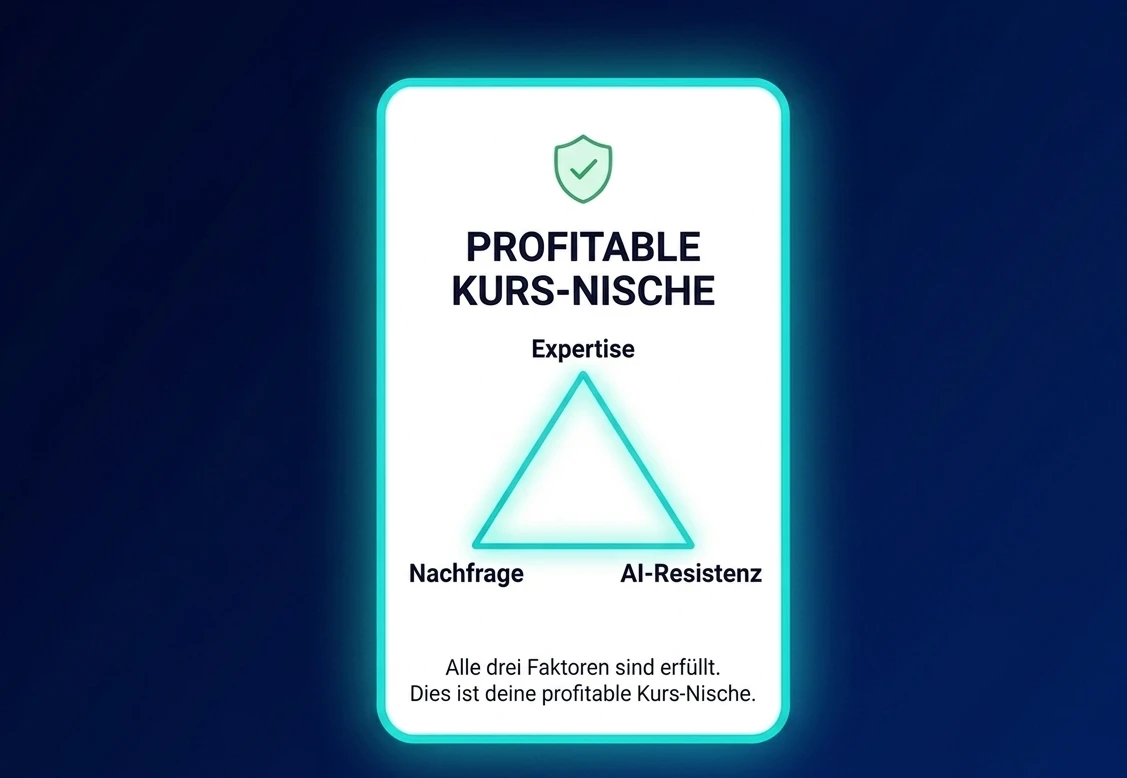
Each side of the triangle, taken without the other two, presents a different problem:
- Expertise with no demand: You know a lot—but no one is looking for it or willing to pay for it.
- Demand without expertise: The market is real—but you lack the credibility to serve it.
- Expertise + Demand Without AI Resistance: You Have a Market—But ChatGPT Is Providing Your Product for Free.
Factor 1: Expertise — What Really Matters?
You don’t need decades of experience or a PhD. But you do need credible expertise—which means, in concrete terms, that you’re at least 12–18 months ahead of your participants’ results.
Four legitimate sources of expertise:
- Professional experience —5, 10, or 15 years in a field—gives you a real edge that no one can replicate through prompt engineering.
- Personal Transformation — You’ve solved the same problem your target audience is facing: lost 20 pounds, overcome burnout, started a business, paid off debt. This isn’t just theoretical expertise—it’s real-life experience that resonates with others.
- Specific degree or certification — Especially in regulated fields (nutrition, psychology, financial consulting), formal qualifications are crucial for establishing credibility.
- Coaching others through the same problem — Anyone who has already guided 10, 20, or 50 people through a transformation process possesses something unbeatable: proven methods, common obstacles, and demonstrable results.
Important: You don’t have to be an expert on everything. You just need to be more knowledgeable than your target audience—and able to facilitate real transformation, not just share knowledge. The difference between imparting knowledge and facilitating transformation is the difference between a course that ends up gathering dust and one that generates testimonials.
Factor 2: Demand — Two types you need to distinguish
Demand means: People are actively looking for a solution to the problem you solve—and they’re willing to pay for it.
Here lies a crucial distinction: interest is not demand. Willingness to pay is demand.
Thousands of people are interested in starting their own business—but only a fraction of them are willing to pay for a structured course. Thousands of people Google “how do I lose weight”—but only those who feel the problem strongly enough and believe in a solution are willing to pay. Your niche needs people in the second group.
The simplest indicator of demand: Are there already courses on your topic that are selling well? If so, that’s proof of market demand. You don’t have to reinvent the wheel—you just need to make it better, more specific, or tailored to a more specific audience.
Factor 3: AI Resistance — The Decisive Filter in 2026
That’s the new factor that will determine the long-term value of a niche in 2026. The question is simple: Can ChatGPT already provide that for free—and do it so well that people won’t pay for your course anymore?
High AI resistance (difficult to replicate):
- Physical abilities and bodywork (strength, movement, manual therapy)
- Deep emotional and therapeutic work that requires presence
- Specific industry or network context (you know the industry from the inside)
- Live support, accountability, and personalized feedback
- Community, peer connections, and social context
- Formal certifications that require institutional documentation
- Cultural or language-specific expertise (German-speaking region, German law, local network)
Low AI resistance (easy to replicate):
- Pure factual knowledge (definitions, concepts, general theories)
- Standardized frameworks without customization
- General advice without specific context
- Simple technical guides for common tools
- Translation services or text summaries
The following applies to the DACH market: Legal and tax-related specifics (GDPR, ZFU, German tenancy law, income tax) are largely resistant to AI—because ChatGPT does not assume liability for specific legal advice and is not familiar with individual circumstances.
Step 1: Create your skills map
Before you conduct an external market analysis, start with what you know: What do you know that others don’t? What have you done that others want to do?
The Competency Map Exercise (30 minutes)
Take a blank sheet of paper or open a document. Create three columns:
Column 1 — Professional Knowledge: What have you learned from your professional experience? What problems have you consistently solved in your professional life? In which area would your colleagues turn to you first? What projects have you successfully completed that others typically fail at? List at least 10 points—no matter how obvious they may seem to you. What seems obvious to you is often valuable to others.
Column 2 — Personal Transformations: What significant changes have you gone through in your own life? Health, finances, career, relationships, personality? What advice would you give your 5-year-ago self today—and how would you convey that in a 10-hour course? Transformation is the strongest form of expertise because you know not only the destination but also the path to get there—including all the obstacles.
Column 3 — Unasked Questions: What do people keep asking you—friends, acquaintances, colleagues, followers? What do they informally ask your advice on? What do you say in social situations that makes people sit up and take notice? These spontaneous questions are free market research—someone considers you knowledgeable enough to ask.
From raw materials to investment ideas
Once you've filled in your three columns, look for overlaps: Where does your professional expertise intersect with your personal transformation? Where does your knowledge align with what people are looking for?
Example: An HR manager with 12 years of experience who has personally gone through a career transition and is constantly asked by female colleagues how to make oneself visible within the company—that’s the foundation for a course on “Career Development for Women in Corporate Settings.” It’s specific, experience-based, and AI-resistant thanks to its personal and organizational context.
The most successful courses don’t stem from a topic that’s simply seen as potentially profitable—they emerge where personal transformation and professional expertise intersect, and where there’s a specific demand for them.
Your Top 3 Course Ideas
Using the competency map, select your three most promising course ideas. Formulate each one as a learning outcome statement:
"My course helps [who] achieve [what result] by [how/using what]."
This phrasing forces you to immediately think about your target audience, the desired outcome, and the method—the three pillars of any compelling course idea. Take the top three ideas to the next phase.
Step 2: Validate Demand — 4 Methods in 48 Hours
Skill alone isn't enough. Now you need to check whether the market exists. This won't take more than two days—if you approach it systematically.
Method 1: Google Trends + Keyword Check
Go to Google Trends and enter your topic—both the broad topic and the specific course-related angle. What you want to see: a stable or growing trend over 12 months. A declining trend is a warning sign, not a deal-breaker—but it needs to be explained.
At the same time: Use Google Keyword Planner or Ubersuggest. Search for the specific problem your target audience is facing—not the topic itself, but the pain point. Not “career development for women,” but “advancing as a woman in the corporate world,” “promotion despite good work,” or “corporate career blocked.” Monthly search volume of over 1,000 for a specific term indicates measurable interest. More important than the absolute number: Are search queries rising or falling?
Method 2: Competitor Analysis on Course Platforms
Search Udemy, Teachable, Digistore24, and catalogs similar to Memberspot for courses on your topic. Interpret what you see as follows:
- Lots of courses, good reviews: the market has spoken—the demand is real, and people are willing to pay for it. That’s no reason to stop—it’s a reason to do it better.
- No listings: In most cases, this isn’t a sign of an undiscovered niche, but rather that there is no market. Very rarely is it a genuine first-mover advantage—in that case, double-check.
- Lots of courses, poor 2-star reviews: This is your chance. Use the critical reviews as a blueprint for creating a better course.
For the top three courses in your niche, note down: price, course length, target audience, and the most common criticisms in reviews. This competitive analysis will give you more market insight in an hour than two weeks of unstructured research.
Method 3: Community Research
Join Facebook groups, Reddit communities (r/coaching, r/personalfinance, r/Fitness, German-language groups related to your topic), and LinkedIn groups. Read 50–100 posts. Take detailed notes:
- What are some of the most frequently asked questions?
- What frustrations keep coming up?
- What words and phrases do people actually use?
- What do people thank others for when they’ve been helped?
This last point is particularly valuable: When someone in a community says, “Thank you, that really helped me—I finally...,” then you’ve achieved a tangible result that people are grateful for. Gratitude is a precursor to a willingness to pay.
The language of the community is also your marketing material. When people describe their problem using specific words, those are the words that should appear on your sales page—not your technical jargon.
Method 4: The ChatGPT Gap Test
Ask ChatGPT directly about your potential course topic: "Explain to me, step by step, how I can achieve [your course topic]."
Then analyze the response with a single question in mind: What’s missing? Where is the response too generic? What is needed that ChatGPT cannot provide structurally—because it requires specific context, personal guidance, community interaction, a local network, emotional support during difficult times, or individual adaptation to a specific situation?
That’s where your unique value proposition lies. The AI Gap Test isn’t a tool designed to instill fear—it’s a tool designed to provide clarity: Your course should deliver exactly what AI can’t.
Step 3: Competitive Analysis — What’s already out there, and where is the gap?
Competition is a good thing. It proves that there is demand. A lack of competition is usually not a sign of an undiscovered niche—it’s a sign that there is no market. Don’t view competition as a rejection, but rather as a guide.
The 5-Step Competitor Analysis
1. Search for the top 3 courses in your niche (Udemy, Google, YouTube, Digistore24). Make a note of the names of the leading providers and their positioning.
2. Read the reviews —especially the 2- and 3-star reviews. Those are the most honest opinions. What are customers missing? What was disappointing? What was missing? What was too vague? These points of criticism are your product specifications.
3. Analyze the course structure —what do existing courses cover, and what do they explicitly not cover? Many courses on a given topic focus on theory—but not on practical application. Or they do not address the DACH context. Or they are not tailored to a specific subgroup.
4. Check the pricing —what are the top providers charging? This will give you an idea of what people are willing to pay in the market. If successful courses are priced at 497 euros, you’ll know that the market accepts this price point.
5. Identify your unique selling points along five possible dimensions:
- A more specific target audience: not "executives," but "team leaders at tech companies with remote teams"
- Specific goal: Not “lead more effectively,” but “reduce employee turnover in the team by 50% in 90 days”
- Alternative method: Different teaching approach, different exercise structure, different format
- Local context: DACH-specific rather than English-language, German law, local platforms
- Underserved community: A segment of the market that is not served by existing courses
Your niche opportunity lies where existing courses are incomplete, too generic, not specific enough to the DACH region, or not tailored to your target audience.
Step 4: The "One Person" Analysis
Before you create a single lesson, answer this question clearly: Who exactly is this course for?
Not: “For people who want to learn X.”
But rather: “For [specific target audience] who have [specific problem] because of [specific context], and who want to achieve [specific result] within [specific timeframe].”
Why specificity does not limit, but rather liberates
A common objection: “If I’m too specific, I’ll alienate customers.” The opposite is true. Specificity creates a sense of recognition. When someone reads your sales page and thinks, “That’s exactly me”—the decision to buy is already 80% made.
Generic communication elicits generic responses. Precise communication creates an immediate emotional connection.
Create a "One Person" profile
Define your ideal participant based on five dimensions:
1. Demographics: Age, occupation, situation (Employee? Self-employed? Parent? Recent graduate?)
2. Immediate concern: What keeps her awake at night? What have they already tried that didn’t work? What frustration is building up right now?
3. Deep-seated goal: What do they really want to achieve—not the superficial answer, but the underlying need? (Not “lose weight,” but “finally feel comfortable in my own body and have more energy”)
4. Beliefs and objections: What is stopping them from taking action right now? Why haven’t they solved this problem yet? What beliefs are holding them back?
5. Previous attempts at a solution: What have you already bought, read, or tried? Why wasn't that enough?
Example — from weak to strong:
Schwach: "For people who want to lose weight"
Stark: “For women between the ages of 40 and 55 who are struggling with weight gain after menopause, aren’t seeing results despite eating a healthy diet, and have been frustrated by previous diets—and who want to understand their hormonal balance in 12 weeks and find a sustainable path to their ideal weight without giving up the things they enjoy.”
This specificity isn't a limitation—it's the foundation of your marketing, your course structure, your pricing, and all your communication. Everything stems from this profile.
Top 15 Profitable Course Niches in the DACH Market in 2026
This list is based on market data from Whop Course Statistics, the Circle Creator Economy Report 2026, a niche analysis by businessheldinnen.com, and DACH-specific market observations for 2026.
What the table doesn't show — and why that matters
Growth alone is not a buy signal. Niche #1 (AI & automation) is growing the fastest—but it also faces the fastest-growing competition from AI tools themselves. Anyone taking a generic AI course today will be competing tomorrow with the next free tool update.
Truly sustainable niches combine moderate to strong growth with high AI resistance and a measurable, tangible outcome. Niches #4 (Leadership), #5 (Wellness/Hormones), #8 (Burnout), and #10 (Presentation) meet this criterion most strongly—because they are based on physical presence, emotional depth, or complex human contexts.
Another factor specific to the DACH market is that niches with a strong local component—such as German tenancy law, GDPR compliance, the ZFU context, and ETF taxation in Germany—have a natural advantage over English-language competition. This is a structural advantage that you should take advantage of.
Testing a niche without a course — Pre-sell and mini-workshop
Before you even turn on a single camera light, before you write a lesson plan or design a sales page: Test your niche with real purchasing intent. Not with surveys, not with questions like “Would you buy something like this?” But with actual purchasing decisions.
According to the 2026 Calmbusiness survey, the most common problem for course creators isn’t production—it’s falling in love with an idea that doesn’t sell. The pre-sell approach completely eliminates this risk.
The Pre-Sale Test
Create a simple landing page—on Notion, Carrd, or directly on your course platform—with four elements:
- Who the target audience is (specifically, as in the one-person analysis)
- What problem it solves (in the target audience’s language, not in technical jargon)
- What specific results are promised (including a timeline)
- CTA: “Sign up for the waiting list” or, better yet, “Pay €97 as an early bird and save 40%”
Promote the page in 2–3 relevant communities, via direct messages on LinkedIn to 20–30 people who fit the target audience, and by mentioning it directly within your existing network.
Goal: 5–10 people who sign up for the waiting list or—even better—pay.
If no one pays or signs up: That’s the most valuable information you can get—and you’ve got it before you’ve invested months in course production. Now you can change your positioning, adjust your target audience, or scrap the idea—without any loss.
When people pay: You have market validation. Now you’re creating content with genuine motivation, real customer expectations, and authentic feedback—which automatically improves your course.
The Mini-Workshop as a Validation Tool
Offer a 90-minute live workshop—for free or for a nominal fee (9–27 euros). The goal isn’t to maximize revenue, but to gather as much market research as possible in a short amount of time.
Why 27 euros is better than free: A small fee filters out participants who are genuinely interested. Free webinars have no-show rates of 70–80%. A small fee increases commitment—and ensures you have participants who are actually listening.
What you'll do in the workshop:
- 60 minutes of real value (no sales pitch)
- 15 minutes for questions, during which you closely observe what is really on the participants’ minds
- 15 minutes before the end: ask directly if there is interest in a full course—and at what price
What you'll have afterward:
- Real customer questions as the basis for your course structure
- First testimonials from the mini-workshop
- Direct feedback on your positioning
- Potential early-bird buyers
- Knowing whether the response is strong enough for a full course
The mini-workshop is the most effective validation tool available—because it tests ideas, gathers market research, and builds initial relationships all at once.
The Waitlist Strategy
In addition to the pre-sale, you can set up a simple waitlist: a landing page, a clear value proposition, and an opt-in form. Promote the waitlist for several weeks before you begin production.
A waiting list of 50–100 qualified prospects is a strong indicator of demand—and gives you an immediate head start when you launch later: people on a waiting list are 3–5 times more likely to buy than those from cold traffic sources.
The 3 Most Common Mistakes in Niche Marketing After Making a Decision
Most niche-related mistakes don’t happen when choosing a niche—they happen in the weeks that follow. Here are the three most common pitfalls that even experienced course creators fall into.
Mistake 1: “I’m going to wait until I’m ready”
There’s no such thing as perfect readiness. The best time for a pre-sell was a month ago. The second-best time is now. Validation doesn’t require complete expertise—it requires enough knowledge to run a mini-workshop. Start with what you know today. Don’t wait for perfection.
Mistake 2: “My market is saturated”
Generic niches are saturated. Specific ones are not. “Fitness” is saturated. “Strength training for women over 50 with knee problems” is not. “Online marketing” is saturated. “LinkedIn marketing for tax advisors looking to win corporate clients” is not. The narrower the niche, the less competition—and the higher the potential pricing. Don’t think in categories; think in terms of target audience problems.
Mistake 3: Choosing the wrong niche
“Which niche will make me the most money?” is the wrong question to start with. It leads you to pursue topics for which you have no real expertise or enthusiasm—which directly affects the quality of your courses, your marketing, and your communication. The right question is: “In which niche do I have genuine expertise, is there proven demand, is the niche AI-resistant, and can I maintain credibility in it over the long term?” Only at the intersection of all three factors can a sustainable business emerge.
Found your niche—what's next?
Once you have a validated niche—you’ve created a competency map, confirmed demand, analyzed the competition, and defined a target audience—there are three specific next steps:
- Developing a Course Structure: From Niche to Curriculum — Which Modules, Which Learning Objectives, Which Formats? (Creating an Online Course: The Complete 8-Step Framework Guides You Through the Entire Production Process.)
- Setting Your Price: What’s the right price for your niche, your deliverables, and your target audience? The 10x Value Formula and the 5-Tier System can help you figure it out. (Online Course Pricing: What Your Course Should Really Cost)
- Choose a platform: Where do you host your course? For the DACH market, GDPR compliance isn’t just a nice-to-have—it’s a legal requirement—especially following the 2025 Federal Court of Justice ruling. (Course platform comparison: The best providers for the DACH market)
If you know your niche and are ready to get started, you need a platform that grows with you—from your first pre-sale page to a scalable course with a community. For the DACH region, that means: GDPR-compliant, 0% transaction fees, and no compromises on data protection. Memberspot delivers exactly that—OMR Leader 2025 in the Coaching & LMS category, Made in Germany, EU hosting, starting at €39/month.
Conclusion: The niche triangle as a guide
A profitable course niche isn’t created through inspiration or intuition—it’s identified through systematic analysis. The niche triangle—expertise × demand × AI resistance—provides the framework. The 4-step process gives you the tools.
Key takeaways from this guide:
- Passion alone isn't enough —it needs demand and a willingness to pay as a foundation.
- The 2026 AI Resistance Test isn't just a nice-to-have —it will determine the long-term future of your niche.
- Validate your idea before production —a pre-sale or mini-workshop can save you months of wasted effort.
- The more specific the target audience, the higher the potential rates —niche experts command daily rates 3–5 times higher than generalists.
- Competition isn't a problem —it's proof of demand. Your job is to stand out, not to avoid it.
By following the process outlined in this guide, you won’t end up with just a course idea—you’ll have a validated market thesis, a precise target audience profile, and a clear differentiation strategy. That’s the difference between a course that sells and one that ends up gathering dust on a shelf.
Further reading for the next steps: Why 90% of all online courses fail—and what the remaining 10% do differently
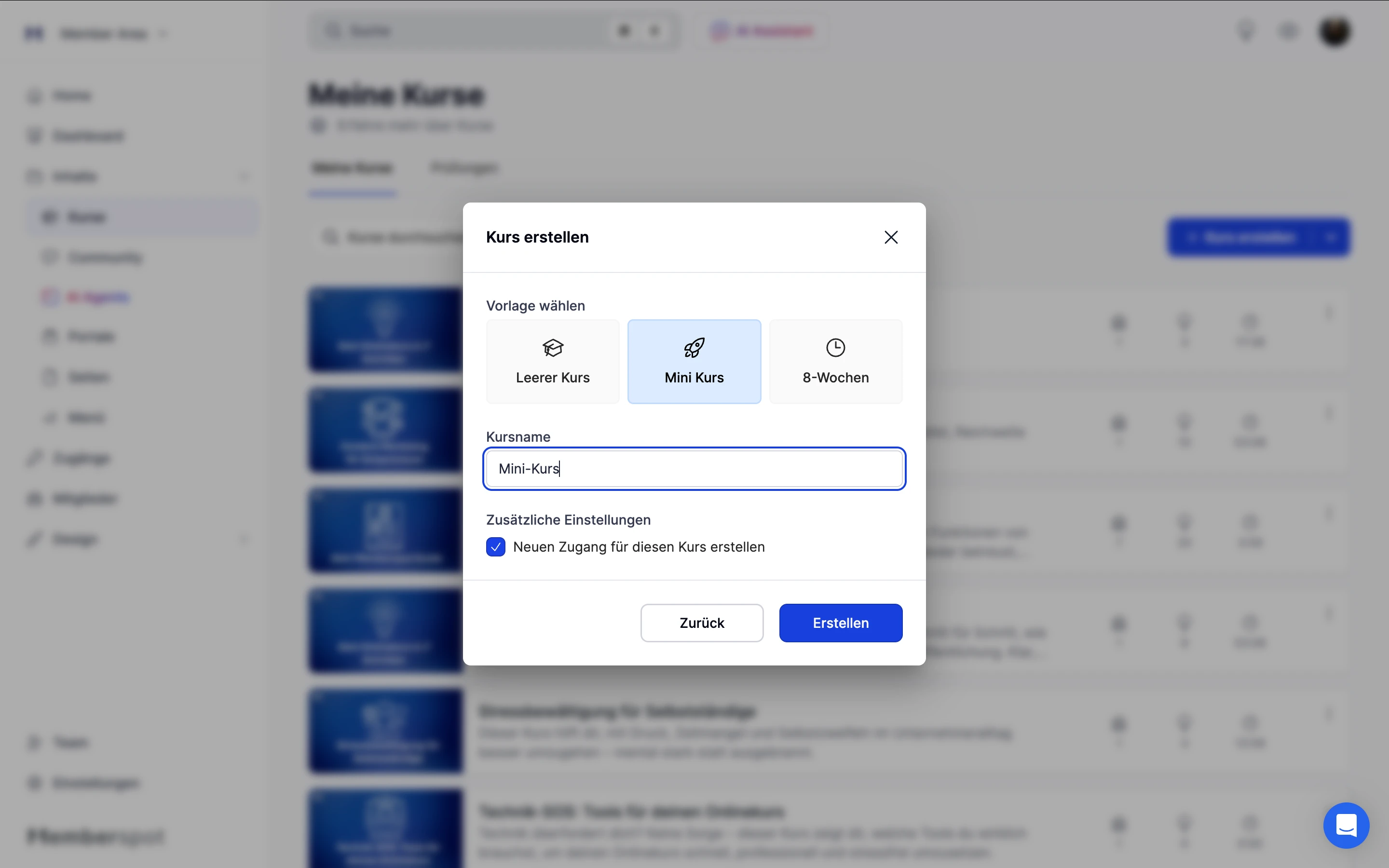
Want to get started right away? Try Memberspot free for 14 days—no credit card required, no risk.