Hardly any other topic divides coaches and trainers as much as this question. The fact is: it is possible to help people and become successful with both models.
So why does the topic of coaching methodology seem to be such a critical question of principle? And what does it really depend on which type of training is more suitable in a particular situation?

We had an intensive exchange with experienced coaches from both camps and what we found out might surprise many a coach or trainer.
Can't stand the tension? Here we have taken a closer look at 4 clichés about group courses.
Most coaches start their business with 1:1 coaching. All it takes is a single client and you can get started straight away without having to invest a lot of time in preparation. This is important because people who want to learn the coaching trade often find it difficult to assess exactly where their clients' problems lie. Creating a complete course from scratch - which is also practice-oriented and delivers results without leaving a lot of questions unanswered - is almost impossible.

In the course of the first 1:1 coaching sessions, a trainer learns a lot about the typical pitfalls and the mindset of their customers. This personal insight helps to bridge the distance between trainer and client and creates a trusting and therefore productive learning atmosphere. As a result, the trainer can really get his clients to put their ideas into practice and see results quickly.
Over time, the coaches gather more and more information and a trail emerges from the various 1:1 sessions, which becomes easier and easier for the coachees and the coach to follow.
As the number of clients increases, coaches begin to recognize the same patterns . The same problems often crop up at a certain point during the coaching session.
To avoid having to constantly repeat themselves, many coaches are therefore starting to record individual videos and create an online course from them. This not only saves the coaches valuable time, but also the clients. In the 1:1 coaching sessions, for example, they can dispense with the discussion of the basics and devote more time to their specific concerns.
Coaches who take the time to work on the company instead of just in the company can scale their business - so that they no longer trade time for money in their coaching sessions but pave the way for long-term growth.
Gradually, the number of customers grows - and with it the video catalog. The coach knows exactly what helps his target group and what doesn't, because the personal contact in 1:1 coaching continues to provide valuable feedback. As a result, the coach learns more and more about how his clients implement the training and how they achieve the best results.
Thanks to the enormous time savings, the coach has the opportunity to develop in parallel with the traditional business. This can mean expanding the coaching offer or focusing on an additional customer group.
In the long term, the question for a coach is not whether 1:1 coaching or a group course is better, but whether they want to scale their business and really take it to the next level.

There are only 24 hours in a day and even coaches need to take a break. In a business model in which every customer is looked after exclusively in person, a natural limit is quickly reached.
When 1:1 coaches get to the point where they receive more requests from clients than they can accept, they have to make a decision.
- One option is to simply turn away prospective clients or put them on a waiting list. The problem: the coach's sales stagnate and potential customers are left with their problems.
- High-price strategy: Alternatively, coaches can start to increase the price of their coaching - a high-price strategy (also known as high-ticket coaching) - in order to reduce demand. Although this generates revenue, it denies interested clients who cannot afford expensive coaching the opportunity to participate in coaching. (We explain here that a high-price strategy can also generate a lot of engagement ).
Both scenarios have one thing in common: the number of customers remains the same. That is the crucial point. A dedicated coach should have a passion for their field and a mission - to get their clients into action, achieve results and help as many people as possible.
This does not mean that traditional 1:1 coaching is not useful. For many customers, it is just the right thing and they benefit optimally from the intensive support. However, scalable group coaching can give an unlimited number of people access to training at a reasonable price.
In the end, the coach achieved more sales and helped more customers with his training.


4 clichés about coaching in groups - and what we think of them
"Group coaching never delivers as good results as 1:1 coaching"
Many coaches recognize the efficiency of group programs, but doubt their effectiveness. To be more precise: 1:1 coaches often have the firm conviction that their client has only managed to implement the coaching and see results through direct discussions. A partially self-taught methodology seems unthinkable to them.
It's understandable: a personal trainer who only supports their clients virtually and in a group often doesn't know at the end of the day whether the course participants are actually putting their training into practice. In the worst case scenario, clients are dissatisfied at the end of the course, have no results and the coach doesn't even know why.
But it doesn't have to be like that. Andreas Baulig - one of the most successful coaches in Germany - says in his book "Wissen macht Umsatz" (Knowledge generates sales)
Group coaching sessions deliver significantly better results than individual coaching
The decisive factor for a successfully scaled group program is to engage the participants. There are various ways to achieve this in group coaching.
One factor is the right pricing. Many successful coaches rely on a high-ticket coaching strategy. If the course is too cheap, there is a risk that clients will not feel obliged to make intensive use of the content. In addition, low prices attract a clientele that does not have the necessary seriousness and is not very interested in learning the course content. Higher prices filter these people out. The bottom line is that with higher costs, fewer people will buy the course - the probability that they will be highly motivated coaching participants is significantly higher. This type of coaching participant has a better chance of success and is more likely to recommend the coaching to others and achieve long-term results.
The structure and content of the group coaching are also important. Different types of content provide variety and adapt to different "learning types". For example, a video course can be offered in parallel as a podcast and transcript so that participants learn the content in the way they prefer. With the help of quizzes at the end of each lesson, participants can check their own learning progress, identify where their weaknesses lie and repeat the relevant modules.
However, it is the online coaching community that makes the decisive difference. The active exchange with other course participants creates a unique group dynamic. This creates synergies - participants share their problems and help each other to develop creative solutions. The feeling of working together towards the same goal and overcoming challenges as a team is a huge motivating factor!
How does group coaching achieve better results than 1:1 coaching?
1. High price strategy
If clients have to make a high (financial) commitment to participate in a coaching session, they are more determined to achieve results, which makes it much easier to implement and achieve optimal results.
2Varied content
Video, podcast, quizzes, live calls - when customers engage with the coaching in different ways, they not only learn intensively but also sustainably.
3. Community
It is easier to learn together, the motivation for implementation does not run out so quickly and there is infinite potential for creative problem solving - all the ingredients to generate sustainable positive results.
"Every customer is different and needs individual support"
Coaching is often aimed at people who have had a specific problem for a long time that they cannot deal with on their own and are therefore looking for professional support. Such a situation is typical, for example, in fitness and diet coaching, dating coaching or business coaching for service providers. In such cases, the client's problems appear to be very individual and therefore cannot be solved with "off-the-shelf" group coaching.
But even in such cases, a group course can lead customers to success and deliver the desired results.
On the one hand, it is very unlikely that a particular situation or problem is actually unique. For most people, it just seems that way. It can be a great support to know that you are not alone with your problems and that other course participants feel the same way.

On the other hand, even the most diverse problems often have the same core, also known as the root cause. If you're a 1:1 coach yourself, you've probably noticed how often you repeat the basics of your course over and over again. A recorded, scalable online course can save the time needed to explain the basics to each client in person. The coach then has sufficient resources available to respond to participants' individual questions in additional 1:1 coaching sessions or live calls.
Another important factor is the specialization of the courses on offer. A very general online fitness training course is obviously not suitable for every customer and quickly comes across as impersonal. This problem is unlikely to arise with a "back fitness course for men over 60".
"Group courses are impersonal, 1:1 coaching is much more intensive"
There is no substitute for the personal bond that is created through 1:1 coaching between coach and client. For many clients, meeting their coaches regularly is a real motivational kick and they look forward to putting the exercises into practice together . However, this does not mean that group courses cannot provide them with additional added value. To recognize this, you should look at the different customer groups in detail.
Existing customers, who are already being coached in person can benefit from having their favorite coach available around the clock. An online course offers them the opportunity to repeat content later. They can also conveniently adapt their coaching to their schedule or take it with them on vacation.
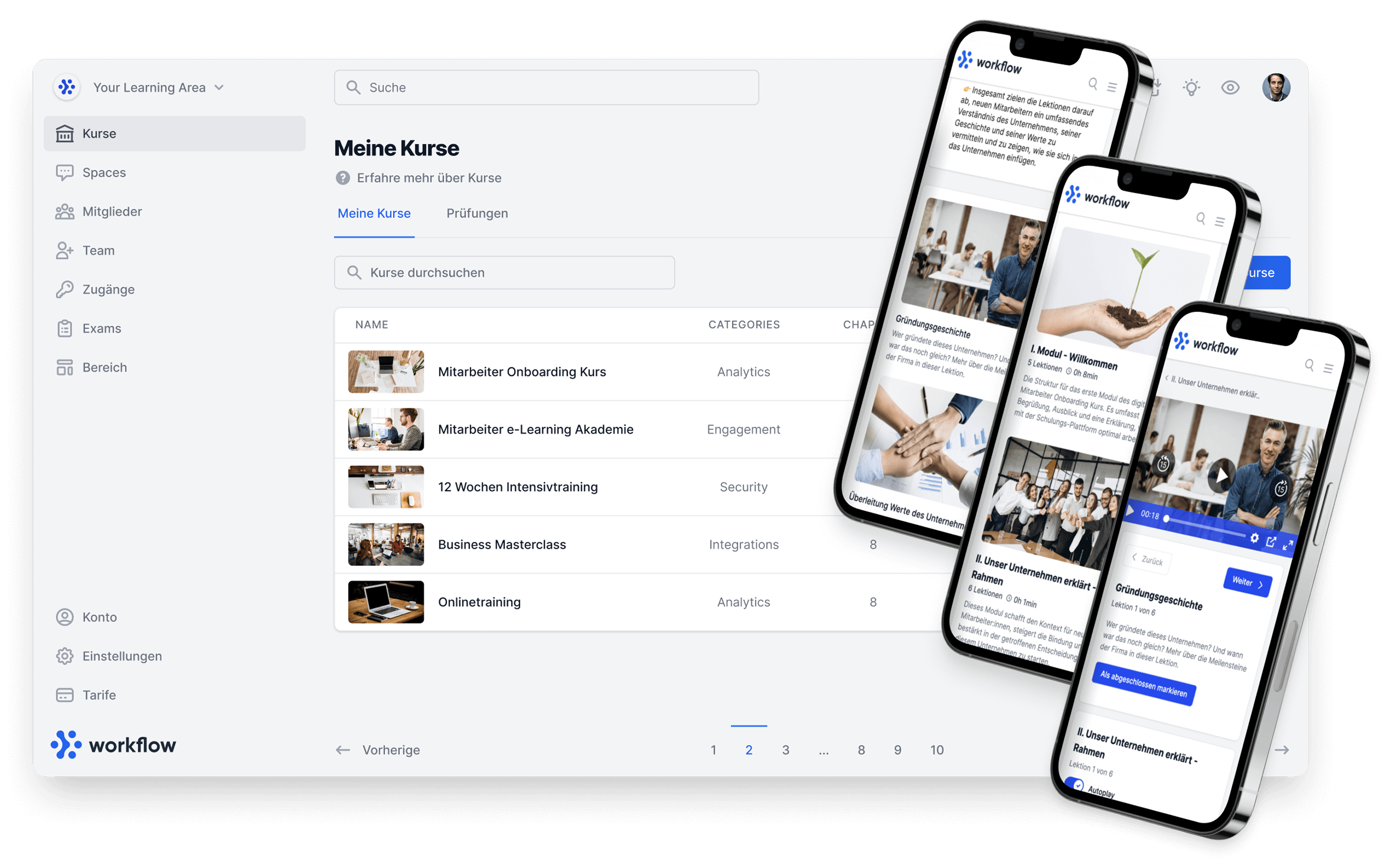
Special bonus: with course platforms such as Memberspot, coaches can also make their training available via their own app - so that coaching participants always have their coach to hand in their pocket.
With the help of a modern course platform, participants can be sent notifications about new content and group discussions can be organized or "homework" can be set. This creates continuous, intensive contact that achieves sustainable results .
New clients are often put off by the high cost of individual coaching. In addition, 1:1 coaching with fixed appointments deprives clients of their flexibility and they quickly convince themselves that they "don't have time for that". Depending on the course topic, individual coaching can also be too personal and therefore uncomfortable for customers. In such cases, group coaching can be a suitable setting in which customers feel comfortable and can talk about difficult topics together.

Coaches can therefore use group courses not only to scale their business, but also to expand their product portfolio and adapt it to different customer groups. This offers customers more choice in terms of cost, time and intensity of the course and reaches a wider range of potential customers.
"My coaching is expensive - clients have a right to personal support"
If a coach offers exclusive coaching for which his clients pay a lot of money, he may feel obliged to meet with the clients in person and give them his full attention in the individual sessions. Charging a similar amount of money for group coaching that takes place virtually may not seem justified to the coach.
However, a scalable group course can also create added value for the customer compared to individual coaching, while taking up the same amount of time for the coach.
Due to the generally high time savings in a group program, the coach has the opportunity to create new content and to convey more content to his clients.
To set an online course apart from the mass of free tutorials and explanatory videos available, the coach can also make it interactive. With live calls and live chats, coaches are also available to their course participants remotely.
The organization and provision of an active community also represents an exclusive bonus for which customers are prepared to pay.

If a coach wants to offer his clients a special experience, he can also organize regional live events where he can get to know the participants personally and they can also exchange ideas with each other.
At this point, it should be clear that switching to group coaching opens up endless opportunities for a coach to scale their business, deliver their content and let their clients decide for themselves how and when they want to engage in coaching. This allows the coach to better implement the coaching and clients can achieve optimal results.
If you would like to start group coaching yourself - whether as an experienced 1:1 coach or at the very beginning of your coaching career - you can now test the Memberspot online course platform for 14 days free of charge.
You can find more information here:
https://www.memberspot.de/blog
Good luck!
Do you still have questions about the online course platform? Just write to us via the chat function on the website or directly to info@memberspot.de.