.webp)
Yes, course platforms will still exist in 2028—but not as you know them today. The question isn’t whether, but how quickly the business model will shift from a content repository to an AI-powered learning infrastructure. Those who miss the boat will be left behind.
Imagine this: The biggest deal in the history of online learning is announced. Coursera is buying Udemy for $2.5 billion. Two of the world’s best-known course platforms—together generating nearly $1.5 billion in annual revenue.
And the stock market? The stock market is yawning. Both stock prices are falling.
That's no coincidence. It's a sign.
Investors know something that most course creators are still in denial about: The business model on which Coursera, Udemy, and thousands of smaller platforms are built—upload a course, sell it, and leave it to run on its own—is facing a fundamental disruption. The merger is not a sign of strength. It is a defensive move.
The merger announcement itself provides the proof: a combined pro forma annual revenue of $1.5 billion and targeted cost synergies of $115 million. That sounds like growth, but it’s Wall Street speak for “we need to cut costs.” When two market leaders merge because market share alone is no longer enough, that’s not an expansion strategy—it’s consolidation out of necessity.
The question that coaches, creators, and platform operators should be asking isn’t, “Is it still worth offering a course?” The question is, “What kind of value will still be marketable in 2028, when AI can generate any content in seconds?”
The publishing paradigm is dead — Josh Bersin's verdict
Josh Bersin is no ordinary person. He is the world’s most influential HR and learning analyst, who has been observing the industry for 25 years. In December 2025, he wrote an article that sent shockwaves through the L&D world: “The Collapse and Rebirth of Online Learning.”
His verdict is clear:
"The 'old model' was a publishing paradigm. We identify areas of need, bring together subject matter experts, and design courses, interactive activities, simulations, and assessments. We then 'publish' them to an LMS (or custom platform) and 'launch' them (or sell them) to users. This is not a minor incremental change: it is a discontinuous shift, and it is happening very quickly."
What Bersin describes is the end of a business model based on a simple logic: an expert knows something → the expert records it → a learner buys access → done. This model worked for 20 years. Today, it has broken down structurally.
The numbers behind this are staggering
According to Bersin’s February 2026 study, traditional training costs an average of $1,252 per learner. AI-powered learning with equivalent or better outcomes: $217. That’s a cost savings of 83 percent.
At the same time, no company can keep up: 74% of companies worldwide can no longer meet their own demand for new skills. The $400-billion corporate learning market is under pressure from two sides at once: costs are skyrocketing, and the half-life of knowledge is shrinking.
The result? Anyone who still designs courses today the way they did in 2019 is producing for a market that won’t exist tomorrow.

If AI can do everything—why do we still need a platform?
Here comes the truly troubling question. Because it’s not just Josh Bersin who’s describing this shift. It’s the CEOs of the world’s most powerful tech companies.
Microsoft CEO Satya Nadella publicly stated what many don’t want to hear: Business applications as we know them will collapse in the age of agents. Ultimately, he said, they are merely “CRUD databases with business logic” that will migrate to the AI layer. His argument: If an AI agent can perform the same task faster, cheaper, and with greater context sensitivity than traditional software—why do we still need the software?
If that applies to CRM and ERP—why should an LMS be any different?
What Gartner Predicts
Gartner is typically cautious about making predictions. This makes it all the more remarkable: 40% of all enterprise applications will incorporate task-specific AI agents by the end of 2026. Starting in spring 2026, Microsoft will embed Copilot directly into LMS environments. Google is rolling out Gemini for Education as a free integration in Google Workspace. Anthropic is launching Claude for Education with the Socrates method for universities worldwide.
These aren't isolated incidents. This is Big Tech moving into the education market.
The AI tutor that's better than your course
A randomized controlled trial conducted by Harvard University in June 2025 showed that AI tutoring doubled learning gains compared to traditional active-learning classes. Khanmigo, Khan Academy’s AI tutor, now has over 700,000 users in more than 380 school districts —after just two years. OpenAI’s Study Mode, which launched in July 2025, shows significant learning gains according to early studies.
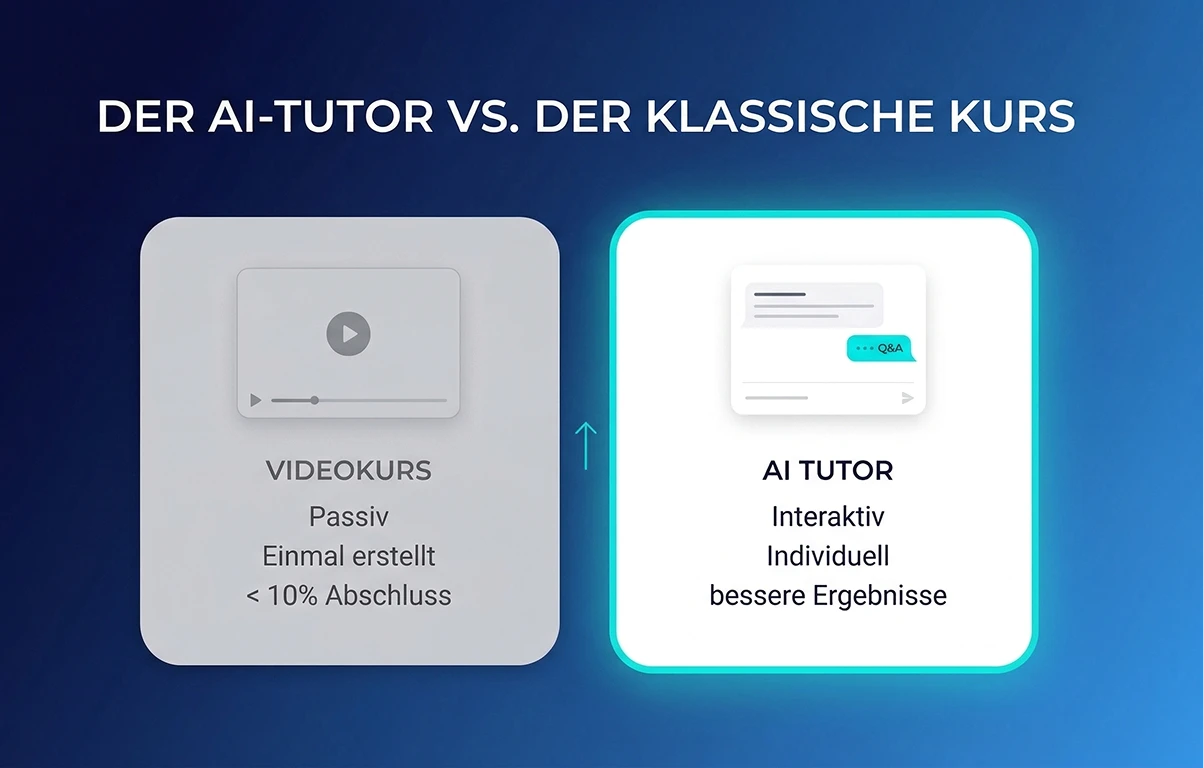
Now for the tough question: If an AI tutor is available at all times, answers individual questions, knows your level of understanding, and adapts to your pace—why would anyone spend 8 hours watching passive video content?
The completion rate problem for online courses is legendary. Most platforms don’t like to talk about it, but completion rates for MOOCs are often below 10%. Online learners have a retention rate of up to 60% —if the format is right. The problem is that the format isn’t right for most courses.
Three Scenarios for 2028
So what’s going to happen? There are three realistic scenarios—and none of them is “business as usual.”
Scenario 1: Displacement (20% probability)
The radical version: AI agents completely replace traditional course platforms. Learners have Copilot, ChatGPT, or Gemini right on their devices. These AI assistants are aware of the current context, the user’s weaknesses, and their daily work routine. So why have a separate platform?
The following factors support this scenario: 62% of companies are already experimenting with AI agents (McKinsey State of AI 2025). 68% of online instructors report that AI has reduced their content creation time by more than 40%—content is becoming a commodity. OpenAI has announced plans to build its own learning platform with embedded courseware.
Arguments against full replacement by 2028 include: institutional inertia. Companies are slow to switch. Compliance and certification require structured documentation. Data protection is holding back pure cloud AI deployments—especially in the EU.
Scenario 2: Transformation (60% probability)
The most likely scenario: Course platforms will still exist in 2028, but they will be fundamentally different. No longer content repositories, but "learning intelligence platforms." No longer passive video viewers, but adaptive, AI-powered learning environments.
We’re already seeing signs of this today:Workday is acquiring Sana Labs, an AI-native corporate learning platform. Accenture is investing $1 billion in LearnVantage and acquiring Udacity. Synthesia has reached a valuation of $4 billion —with AI avatars that no longer just produce videos, but serve as interactive training agents.
In this scenario, there will be a clear market in 2028:
Scenario 3: Coexistence (20% probability)
The optimistic scenario: AI and traditional course platforms coexist because they serve different needs. AI agents provide just-in-time knowledge, while course platforms offer structured, guided learning with a human touch.
The K-shaped growth of the market suggests that professional certifications are growing by 14% annually, while generic courses are stagnating. Those who position themselves will survive. Those who produce commodities will perish.
What makes this scenario less likely: the speed of adoption. According to a 2025 RAND study, AI usage among educators rose from 25% to 53% in just a single year. OpenAI’s Study Mode brought the Socratic method to all users—for free. Gemini for Education is free in Google Workspace. When disruption comes at no cost, adoption accelerates exponentially.
What survives—and why
Let’s be honest: Not every part of today’s online course platform business will still be around in 2028. But some aspects are structurally immune to AI disruption.
Community is the strongest moat
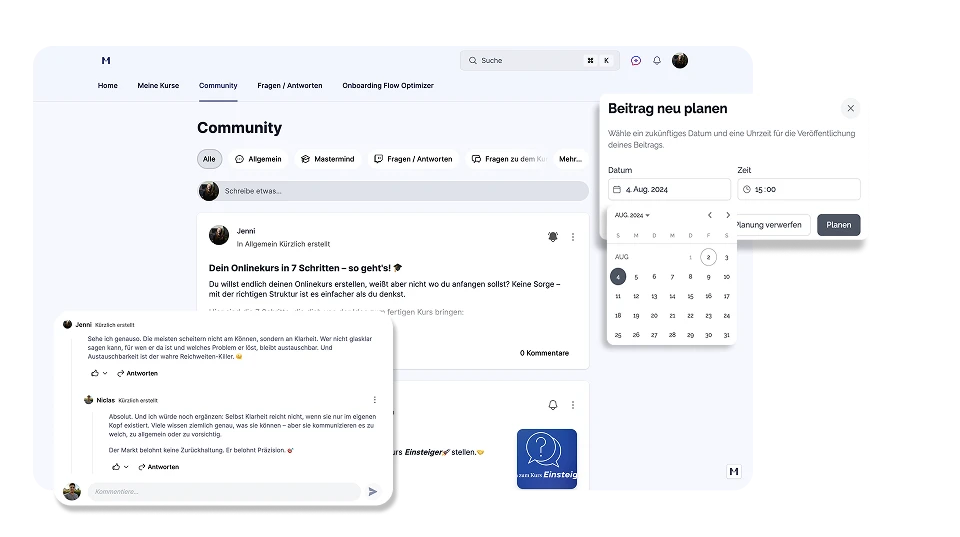
AI can generate content. AI can answer questions. AI can adapt learning paths. But AI cannot create genuine human connections—and the more of everything is AI-generated, the more valuable authenticity becomes.
This isn’t nostalgia. It’s market logic. Consumer trust in AI-generated content has dropped from 60% to 26%. At the same time, 91% of creators are already using AI tools —which means that AI-generated content is becoming the norm, and human curation is becoming a key differentiator.
Dr. Shawn Wigg aptly describes the paradox: "Discussion posts used to simulate in-person discussion. Now you get bullet-point answers that reek of AI, and before you know it, one algorithm is answering another."
The more AI-generated content floods the world, the more valuable the real thing becomes. The authentic. The peer who knows the same struggle. The community where mistakes are shared honestly. Forbes confirms the trend: Community will become a decisive factor for creators and brands by 2025.
Credentials are becoming more valuable, not less
Here’s the irony: the more AI-generated content floods the world, the more the value of verified, human-validated credentials increases. Who can still prove that they’re actually capable of doing something?
Gartner predicts that 75% of all hiring processes will include AI proficiency tests by 2027. This does not signal the end of certifications—it signals their transformation. Certifications that truly demonstrate proficiency are becoming a scarce resource.
Transformational Coaches — the Last Bastion
In February 2026, Ruth Kudzi MCC said something that I believe to be fundamentally true: "AI doesn't replace coaching; it highlights the difference between transactional models and deeper, transformational work."
BCG predicts that 70% of all L&D organizations will be using human-AI hybrid models by 2027. AI for accountability, reminders, and pattern recognition. People for what truly drives transformation. This isn’t a threat to good coaches. It’s a differentiator that will drive mediocre coaches out of the market.
The paradox here is that the more AI permeates the workplace, the greater the hunger for genuine human connection becomes. The market for human coaching is growing—not because AI is failing, but because AI brings the need for human depth into sharp relief. BetterUp Labs reports three times higher engagement in hybrid coaching programs compared to purely digital offerings. Coaching as a product isn’t going away—it will split into two categories: mass-market offerings for AI, and premium offerings for humans.
What this means for coaches and creators — concrete recommendations for action
You're a coach, creator, trainer, or consultant. What are you going to do now? No empty platitudes here—just concrete decisions.
1. Stop selling content—sell transformation
"Selling knowledge alone is like selling bottled water next to a waterfall." (Boss Project, September 2025). That’s the most accurate description of the problem I know. AI is the waterfall. Your 10-module course is the bottle.
What People Will Buy in 2028: Results. Change. Access to a community that helps them grow. The ability to actually put things into practice—not just understand them.
Specifically: Turn your course into a program. No lifetime access without guidance. Instead: a structured learning path, live sessions, a community, and accountability. That’s harder to commoditize.
2. Use AI to boost efficiency — but sell the human touch
68% of online instructors report that AI has reduced their content creation time by more than 40%. That’s your advantage—take advantage of it. Let AI generate outlines, write scripts, transcribe videos, and automate FAQs.
Then reinvest the time you’ve saved in what AI can’t do: real calls with your customers. In live sessions. In personal feedback. In community building.
In other words: If AI saves you 40% of your content creation time, don’t use that time to produce more content—use it to create more human touchpoints.
3. Specialization is a survival strategy
The K-shaped growth of the e-learning market is clear: niche experts command daily rates 3 to 5 times higher than generalists. While generic courses are stagnating, professional certifications in specialized fields are growing by 14% annually.
The e-learning market is projected to grow to $665 billion by 2031 —but this growth is concentrated. Companies that deeply serve a niche market are hard to replace.
Specifically: Identify the most specific, valuable skill you possess. Not “business coaching”—but “growth strategy for SaaS founders with ARR between 1 and 5 million.” The narrower the niche, the harder it is for AI to replicate.
4. Platform diversification is a must
This consolidation shows that if you rely solely on a single platform, you’re at the mercy of its decisions. Coursera and Udemy are merging. What will happen to your courses? What about your data? What about your audience?
The creator economy is projected to grow to $600 billion by 2030 —but 48.7% of creators earn less than $10,000 a year. The gap is widening. Those who run their own platform with its own community have a structural advantage.
In short: Always build your audience on channels you control. Email list. Your own platform. Direct relationships with your customers—independent of marketplace algorithms.
5. Learn AI — now, not later
According to Gartner, 80% of the engineering workforce will need to be upskilled in GenAI by 2027. AI skills are explicitly required in 7 million U.S. job postings—a sevenfold increase since 2023. This is the area where you can build your expertise.
Anyone who understands and teaches AI will be on the right side in the coming years. Not as a competitor to AI—but as someone who helps others use it.
Conclusion: The platform question is the wrong question
Will there still be trading platforms in 2028? Yes. But most of them will be unrecognizable. Ultimately, the question of whether platforms will survive is not the crucial one.
The key question is: What is your value if AI takes over the content part of your offering?
Those who answer this question today—and adapt their offerings accordingly—will benefit from disruption, not suffer from it. The coaches and creators who invest in community, credentials, and genuine human connection will be stronger in 2028 than they are today.
The others? By 2028, they’ll be searching Amazon Marketplace for the next specialized information product that hasn’t been commoditized yet.
The choice is yours.