


Somewhere between the third Kajabi tab and the sixth YouTube video about "the best course platform in 2026," it happens: You still don't know which one to choose. The comparison articles you've read list tools—without telling you what that means for your business. No GDPR risk. No real true-cost comparison. No answer to the real question: What will the wrong decision actually cost you?
With Teachable Basic, you pay a 7.5% transaction fee. On €300,000 in annual revenue, that’s €22,500 down the drain. Every year. Just because you chose the wrong platform. This guide shows you what the math really looks like and which platform is actually the right fit for each type of provider.
.webp)
A frank disclaimer: We at Memberspot obviously have a vested interest in you choosing us. We’re not going to beat around the bush about that. That’s exactly why we also show you where other platforms objectively perform better for specific use cases. A comparison you don’t trust doesn’t help anyone—and losing your trust through excessive self-promotion costs us more than an honest mention of the competition.
The DACH Platform Decision-Making Framework
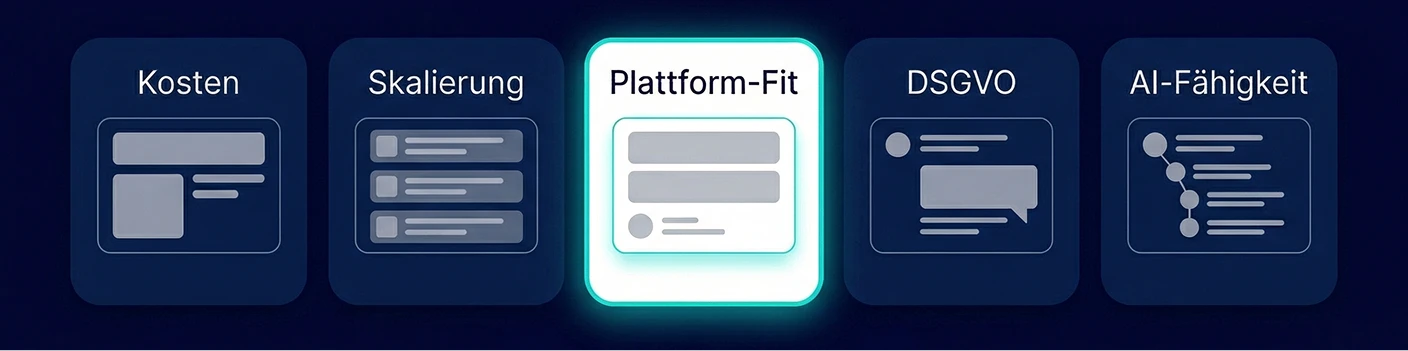
Before you dive into the tables: There is no single “best” course platform. There is, however, the best platform for your specific situation. The DACH Platform Decision-Making Framework filters your choice based on four criteria:
Dimension 1: Creator Type
: A solo coach with a core course, or a trainer with 10+ products? An agency that manages training infrastructure for multiple clients, or a scale-up with its own team? The features you need differ radically.
Dimension 2: Feature Depth
Just courses, or also a community, marketing funnels, email automation, a white-label app, and AI creation? Those looking for an all-in-one solution will consider different options than those who just need a clean course platform with strong GDPR compliance.
Dimension 3: Geographic Focus
Are your customers exclusively from the DACH region? If so, GDPR compliance and German-language support are deal-breakers. Planning to expand internationally? In that case, features such as multilingual interfaces and international payment methods become relevant.
Dimension 4: Cost Structure at Target Revenue Levels
What does the platform cost at annual revenue levels of €30,000, €100,000, and €500,000—including transaction fees? For some platforms, this figure can be surprisingly different from what the starting price suggests.
You'll find the specific recommendations from this framework at the end of the guide. First, the data.
The Comprehensive Comparison Chart: 10 Platforms, 12 Categories
As of March 2026. All prices are in € or $, on a monthly basis with annual billing, and include the most affordable starter plan with full course functionality.
Sources: Platform pricing pages as of March 2026; kopfundstift.de Course Platform Comparison; blogmojo.de Online Course Platforms; OMT.de Course Platform Comparison
Each platform is evaluated individually
Tables are just the starting point, not the end. Here’s an honest look at each platform—its strengths, weaknesses, and who it’s best suited for.
Memberspot — The DACH Standard
Memberspot was founded in Ludwigsburg in 2020 and is now the leading German course platform, with over 4,500 customers and 2.2 million users. Its designation as an OMR Leader 2025 in the Coaching and LMS categories is an external endorsement, not self-promotion.
Strengths:
- Made in Germany: Hosting on servers in the EU, AVV contractually included, no GDPR workarounds
- 0% transaction fees on all plans — it may seem like a small thing at first, but it becomes a significant advantage as your revenue grows
- AI Studio: GDPR-compliant AI course creation directly within the platform, with no data transfer to U.S. systems
- White-label app: Participants download your app from the App Store—featuring your logo, colors, and name
- DRM protection for video content: prevents unauthorized downloads
- Community integrated: no separate tool, no separate data management
- Automatic certificates upon course completion
- Support with a response time of less than 10 minutes in German
Weaknesses (honestly):
- Marketing automation (email funnels, landing pages) isn't as robust as it is on Kajabi—if you want a complete marketing stack all in one platform, you'll need to use external email tools like ActiveCampaign or Brevo with Memberspot
- To make getting started as easy as possible, Coachy has been streamlined even further
- Price: starting at €99/month — cheaper than Kajabi, but not free like the Systems.io starter plan
Who it's for: Coaches, trainers, consultants, and content creators in the DACH market who take GDPR compliance seriously, want to grow their businesses, and need a professional platform that brings together a community, an app, and AI under one roof.
Coachy — The Quickest Way to Get Started
Coachy is the simplest German-language course platform—fewer features, but a quick start and the lowest price.
Strengths:
- The most affordable option in the DACH market (starting at €35/month)
- It's incredibly easy to use—really: you don't need a tutorial
- 0% transaction fees
- Servers located in Germany, GDPR-compliant
Weaknesses:
- No white-label app
- No built-in AI features
- Limited community features
- Fewer integrations than Memberspot or Kajabi
- Very little DRM protection
Who it's for: Coaches who are just getting started and don't need complex features. To scale beyond a basic plan, you'll need to switch platforms—which involves some effort.
Ablefy (formerly Elopage) — The DACH Tax Specialist
Ablefy is the rebranded version of Elopage and offers a unique selling point in the DACH market: the reseller model. Ablefy acts as a reseller when selling your digital products—which means that VAT processing for B2C sales is handled by Ablefy, not by you.
Strengths:
- Reseller model: automatic VAT processing, easier for courses offered to individual customers
- German-speaking, focused on the DACH region
- Integration with Digistore24 for affiliate marketing
Weaknesses:
- 3.9–7.5% transaction fees — once sales reach a certain threshold, the tax benefit is more than offset by the transaction costs
- No DRM protection, no white-label app
- The rebranding confusion (Elopage → Ablefy 2024/2025) has left many users feeling uncertain, as reported by sabinesatzmacher.de
Who it's for: Coaches with low revenue who want to actively use the reseller tax model and don't need an app. If your annual revenue is around €50,000 or more, you should weigh the transaction fees against the cost of a tax advisor and a more affordable platform.
Kajabi — The All-in-One Heavyweight
Kajabi is the most widely used course platform in the world and dominates the English-speaking market with a content ecosystem comprising over 247 blog posts, podcasts, webinars, and its own university. As a platform, Kajabi is unique: courses, email marketing, landing pages, sales funnels, webinars, community features, and podcasts—all in one system.
Strengths:
- Best Marketing Ecosystem: Native email automation, sales funnels, and landing pages
- 0% transaction fees
- Extensive integrations
- AI Features for Course Structure and Marketing
- Strong community features
Weaknesses:
- Starting at $89/month — that's three times the price of Coachy and more than double that of Memberspot
- U.S. Hosting: All data is processed in the United States. The EU-U.S. Data Privacy Framework (2023) has formally regulated this, but it remains politically vulnerable. Schrems III is on the horizon.
- No DRM protection for videos
- English-language platform — Support in English, user interface for participants in English (can be localized, but this is a complex process)
- Not a true white-label app
Who it's for: Creators who want to consolidate their entire marketing stack into a single platform and who can manage the challenges of US hosting with a proper GDPR setup (Terms of Service, Privacy Policy, User Information). Kajabi is the most robust all-in-one solution for international creators.
Teachable — The Budget-Friendly Option with a Costly Catch
For years, Teachable has been the go-to platform for new course creators, but its transaction fee structure on the Basic plan is a significant drawback.
Strengths:
- The easiest way to get started among U.S. platforms
- Automatic certificates
- Zapier integration
Weaknesses:
- 7.5% transaction fees on the Basic Plan — that’s unusually high for a trading platform in 2026
- No community features
- No app for participants
- U.S. Hosting, GDPR Risk
- Limited AI features
Who it's for: Hardly worth recommending in the DACH market anymore. If you're looking for an affordable option, Thinkific (0% transaction fee) or Coachy (hosted in Germany) offer better deals.
Thinkific — The Flexible U.S. Alternative
Thinkific has evolved from a creator platform into an enterprise LMS, but it still offers a robust course platform with 0% transaction fees.
Strengths:
- 0% transaction fees
- Flexible course structure and community integration
- Good integrations
- Scales with your business (from Starter to Enterprise)
Weaknesses:
- U.S. Hosting, Schrems II Risk
- English-language platform and support
- AI features are still limited
- Not a true white-label app
- Increasing focus on B2B/enterprise, less on solo creators
Who it's for: Creators who want to scale internationally, don't have any GDPR issues, and are looking for a flexible, clean platform with no transaction fees.
Skool — The community-first platform with a DACH issue
Skool gained attention in German-speaking countries in 2024/2025 because U.S. creators like Alex Hormozi publicly recommended it. The reality for providers in the DACH region is sobering.
Strengths:
- A very simple community experience with gamification (points, leaderboards)
- Discovery Feature: New members can browse and discover Skool communities
- Flat-rate pricing: $99/month for everything
Weaknesses:
- No AVV available — this effectively renders Skool unusable for coaches in Germany, Austria, and Switzerland if participant data must be processed in compliance with the GDPR
- US hosting without an EU option
- Entirely in English — no localization for German-speaking participants
- Course features are very limited (Skool is primarily a community, not an LMS)
- No certificates, no DRM, no app
Who it's for: U.S. or international creators who prioritize their community and have no GDPR concerns. For the DACH market: not recommended without significant legal risk.
GDPR Score: What You're Really Risking with Your Participants' Data
This is the section that most course platform comparisons leave out. Yet it is the most important deciding factor for providers in the DACH region.
Since the ECJ’s Schrems II ruling (2020), the transfer of personal data to the U.S. without adequate safeguards has been unlawful. The current EU-U.S. Data Privacy Framework (in effect since July 2023) has formally eased the situation—but has not fully resolved it. The framework is based on a U.S. presidential executive order, not on federal law. It is legally possible for the ECJ to overturn it again. As a course provider, the responsibility for this lies not with the platform—but with you.
GDPR Score Table: 10 Platforms Put to the Test
A GDPR violation doesn’t just cost you a fine (up to 4% of your global annual revenue or €20 million). It costs you your customers’ trust. No DACH coach who has built up their business over the long term would risk that for $5 less a month.
True Cost: What Scale's Transaction Fees Really Cost
This is where the price tags start to get a bit steep for some platforms.
What TX fees mean
Transaction fees are charged on the gross sales price—not on your profit, not on your net price. With a 7.5% transaction fee and a €300 sale, €22.50 goes directly to the platform before you even deduct taxes or other costs.
Example 1: €50,000 in annual revenue
Calculation Example 2: €300,000 in annual revenue
What these figures mean
The difference between Memberspot and Teachable Basic at €300,000 in revenue: €22,482 per year. That’s the price of a mid-range car. Every year. For the wrong platform.
"0% transaction fees" isn't just a marketing slogan—it's a fundamental decision that underpins Memberspot's business model. We earn revenue from subscriptions, not from your sales.
Basis for calculation: Platform pricing pages as of March 2026; Teachable Pricing; Ablefy Prices
Comparing AI Features: Substance Over Hype
According to the Circle Creator Economy Statistics 2026, 75% of creators use AI for content creation, and 68% plan to expand their use of AI. A platform without native AI forces you to use external tools—and transfer data between systems. This is inefficient and, in the DACH market, also raises data protection concerns.
Memberspot AI Studio is the only GDPR-compliant AI course creation tool in the DACH market that is directly integrated into the course platform. Course structure, lesson content, and quizzes are generated from a single input without any data leaving the EU infrastructure.
LearnWorlds currently offers the most technically robust AI features (interactive videos, automatic summaries, e-book generation)—though providers in the DACH region should note that the platform is hosted in the U.S.
Mobile & Apps: Who uses a laptop to study these days?
LMS Ninjas shows that mobile-first learning significantly increases course completion rates—because learners study during short breaks in their daily routines rather than scheduling dedicated laptop sessions. The average course completion rate is 12.6%, according to the DEV Community 2026. Mobile optimization is one of the most effective ways to address this.
The Memberspot white-label app works like this: Your members search for your name in the App Store. They see your logo. They open your app. No Memberspot logo on the splash screen, no third-party branding. That’s the difference between having your own brand and being a subtenant on a SaaS platform.
Community Features: Who Actually Needs Skool?
According to the Circle Creator Economy Statistics 2026, 88% of creators will monetize through memberships in 2026—up from 54% the previous year. Community is no longer an optional add-on. It is at the core of the business model.
The dilemma many coaches face: They want to build a community, but they only know about Skool or Facebook groups. Here’s the full picture:
Skool ($99/month): Community-first with gamification, a discovery feature, and a very simple interface. For coaches in Germany, Austria, and Switzerland: no AVV available, US hosting, platform in English only. Legally not acceptable for German providers with B2C participants.
Circle ($89/month): The cleanest community platform—flexible, modern, and packed with course features. Also based in the U.S. It’s pricey as a standalone tool if you need a course platform anyway.
Mighty Networks ($49/month): Community + courses + app, U.S.-based, community-driven. Not ideal for the DACH region.
Memberspot: A community seamlessly integrated into the course platform. No duplicate costs, no separation of tools, and fully GDPR-compliant. Participants can navigate between course content and community discussions within the same app. This is the integrated approach that 45% of creators are looking for—according to Circle 2026, 45% are actively consolidating their tech stack.
Integrations: What Your Course Platform Needs to Connect With the Rest of Your Business
A course platform rarely stands alone. You need email marketing, CRM, payment providers, analytics, and possibly a webinar tool. How well your platform integrates with this stack can save you dozens of hours of work each year.
The critical integrations for DACH-Creator
Email marketing: If you don’t have a native email tool (Memberspot, Coachy, Thinkific), you’ll need to integrate with ActiveCampaign, Brevo, Mailchimp, or ConvertKit. Most platforms support this via Zapier or a direct API.
Payment providers: Stripe and PayPal are standard. Important for the DACH region: If you want to accept direct debit (SEPA) or instant bank transfer, you’ll need to configure Stripe accordingly or use an alternative provider.
Automation: Zapier and Make (formerly Integromat) are the most widely used no-code automation tools. For example, if you want to tag a new purchase in ActiveCampaign or trigger an automated follow-up after a course is completed, you need a reliable Zapier/Make integration.
Integration Overview: Which platform connects to what?
Kajabi is the clear winner here in terms of integration depth—which fits its all-in-one approach. Memberspot offers solid core integrations for standard DACH requirements. Skool is by far the most isolated: anyone building on Skool is building within a closed system.
When Zapier/Make Isn't Enough
For simple trigger actions ("Course purchased → Add tag in email tool"), Zapier is perfectly sufficient. If you need more complex automations—personalized learning paths based on quiz results, dynamic segmentation based on progress, AI triggers—you’ll need either a platform with a native automation module (Kajabi Pipelines) or a custom integration via API.
Changing Platforms: What the Switch Really Costs
Anyone who has chosen the wrong platform will eventually consider switching. What’s holding them back? The perceived effort involved. The good news: it’s nowhere near as much as most people fear.
What needs to be transferred when switching platforms
- Course content: videos, PDFs, texts, quizzes — most of it can be transferred manually or with migration support
- Participant data: No problem if the switch is GDPR-compliant (both platforms have a data processing agreement). Export member data as a CSV file and re-import it.
- Purchase history: Existing subscriptions can be migrated on some platforms (Stripe subscription transfer available); on others, subscribers need to create new accounts
- Domain: Change custom domain — DNS update, 15 minutes
- Sales pages and marketing assets: These need to be created from scratch—this is where the real work lies
Realistic migration times
Memberspot offers active migration support—a technical contact person who assists with the transfer. This significantly reduces the perceived effort involved.
Why switching is worth it — and when it isn't
It's worth switching if:
- You pay a 7.5% transaction fee and generate over €30,000 in annual revenue (the savings will outweigh the migration costs within a few months)
- You are exposed to GDPR risks and want to address them
- You're on a platform that doesn't give you access to important features (app, community, AI)
It's not worth switching if:
- You've been on the current platform for less than 12 months and are still in the growth phase
- Your annual revenue is still below €15,000 (the savings on transaction fees are too small to justify the migration effort)
- You're currently planning a launch — never perform migrations at the same time as a launch
Pricing models on the platforms: What you can set
Not every platform supports all pricing models. That may sound like a minor detail—but it’s crucial when it comes to pricing strategy.
Which platform supports which pricing models?
For most coaches, a one-time purchase plus a monthly subscription plus coupon codes are more than enough. Those who need payment plans (e.g., 3 installments of €333 instead of a one-time payment of €997)—a proven conversion tool in the DACH market—should check the platform’s support for this feature in advance.
Choosing a Platform by Creator Type: The Framework in Practice
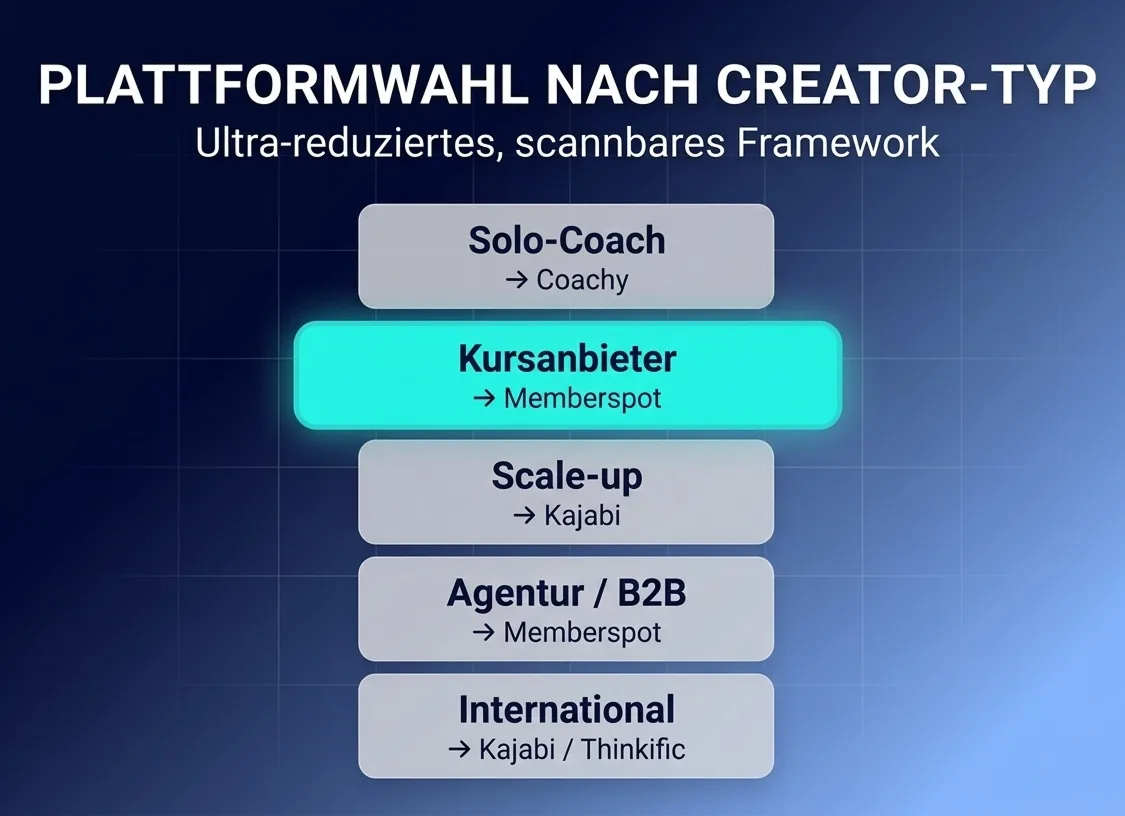
Profile 1: Solo Coach, Starting Out (Revenue: €0–30,000/year)
You have a core course or a one-on-one program. You want to get started, not spend years setting things up. Tech isn't your strong suit.
Recommendation: Use Coachy for the first 6–12 months. If you find that the community, app, or AI features become important to you, switch to Memberspot—the import process is straightforward. Both are GDPR-compliant and have a 0% transaction fee.
Kajabi is too expensive and too complex for this purpose. Teachable or Thinkific: U.S.-based hosting with no added value for the DACH region.
Profile 2: Course providers with multiple products (€30,000–€200,000 per year)
You have 3–10 courses, maybe a membership, want to offer an app, and don't want to manage 5 different tools.
Recommendation: Memberspot. The platform’s sweet spot. Community, app, AI Studio, DRM, certificates, Zapier integration—all in a GDPR-compliant environment.
Profile 3: Scale-up with a focus on marketing (€200,000+ per year)
You have funnels, email sequences, and webinar automation, and you want to manage everything on a single platform. Marketing automation is your key tool.
Recommendation: Kajabi with proper GDPR setup — if marketing automation is the key feature. Or: Memberspot + a dedicated email tool (ActiveCampaign, Brevo) for a more streamlined GDPR solution.
Profile 4: Agency / B2B Trainer (Corporate Clients)
You provide training to multiple companies, manage different client instances, and require white-label solutions and certificates. A typical scenario: A management consulting firm that operates separate training infrastructures for three corporate clients—each with distinct branding, separate participant databases, and dedicated reporting.
Recommendation: Memberspot (multi-tenant). One instance, multiple clients, separate areas, automatic certificates. For agencies that want to scale without having to manage a separate subscription for each client. GDPR compliance isn’t just a nice-to-have for B2B corporate clients—it’s a prerequisite for signing a contract.
What multi-client support actually means: Client A sees only their own courses and participants. Client B sees only theirs. As an agency, you see everything. Each client can have their own logo and color scheme. Certificates bear the name of the respective company. With individual subscriptions per client, this structure would result in logistical chaos—and multiple costs.
Profile 5: Creator with a focus on international growth
You want to expand beyond the DACH region, have English-language content, and are planning launches in the U.S., the U.K., or Australia—and GDPR isn’t your primary concern because your target audience isn’t focused on the EU.
Recommendation: Kajabi for an all-in-one marketing stack, or Thinkific for a cleaner, more affordable course solution with 0% transaction fees. Both are based in the U.S. and well-suited for international scaling.
Important: Even companies that are expanding internationally often have a significant portion of their target audience in the DACH region. For those who want to capture this audience without sacrificing their international reach, Memberspot with Zapier integration for international email tools is a solid solution.
What Creators Really Regret: The Most Common Platform Mistakes
In conversations with course providers in the DACH market, the same four common pitfalls have repeatedly come to light.
Mistake 1: Choosing Teachable because of its low starting price
The "Free" tier or basic plan looks tempting. Then the business grows—and the 7.5% transaction fees become a real problem. With €100,000 in revenue: €7,500 per year for the platform. Switching then costs time, causes stress, and in the worst-case scenario: migrated users who have to sign up again. Tip: Start on a 0% transaction fee platform from the very beginning.
Mistake 2: Buying Kajabi for a small business
Kajabi starts at $89/month and offers a vast array of features. If you’re just launching your first course, you won’t need 80% of those features—but you’ll still be paying for them. Kajabi is worth it once you reach an annual revenue of around €100,000, provided you’re actively using email marketing automation and sales funnels. Below that threshold, it’s an expensive overkill.
Mistake 3: Underestimating WordPress and Plugins
"WordPress is affordable" is only true if you don't factor in the time it takes. Anyone who sets up a members-only area on WordPress will sooner or later run into plugin conflicts, update issues, GDPR concerns with hosting, and the lack of a native app. With SaaS, you pay for the service—with WordPress, you pay with your time.
Mistake 4: Waiting until the first problem arises to check for GDPR compliance
German-speaking coaches who use Kajabi or Teachable without having signed a DPA and updated their privacy policy accordingly are exposing themselves to legal risk. The problem isn’t that you’re using a U.S. platform—the problem is that you haven’t documented it. Data protection authorities don’t care what you didn’t know. They care about what you didn’t document.
Platform Development: Where Are We Headed by 2028?
Course platforms are on the verge of a structural transformation. The traditional distinction between "course tools" and "community tools" will become blurred—all major providers are moving in the same direction.
Trend 1: AI as a standard, not as a feature
By 2028, every major course platform will offer AI-powered content creation. The question isn’t whether they will, but how well they’ll do it and how compliant they’ll be with the GDPR. For providers in the DACH region, the issue of AI data protection is more critical than AI quality: What data goes where?
Memberspot AI Studio and the approach of keeping AI processing on EU infrastructure isn’t just a niche feature—it’s the answer to the question everyone will be asking in two years.
Trend 2: Apps as a Competitive Advantage
Offering members a professional white-label app builds a psychological brand loyalty that a website can never achieve. The app provides that premium experience. Platforms without an app option are becoming increasingly unattractive to professional providers—because 70% of users want to learn on mobile devices.
Trend 3: Community as a retention tool
The shift in the creator economy away from "one-time course sales" toward "membership models" is irreversible. Creators who lack community features will lose members to platforms that offer them. According to Circle 2026, 88% of creators will monetize through memberships by 2026. A course platform without community features meets only half of the demand.
Trend 4: Compliance Becomes a Key Product Factor
The EU AI Act (effective February 2025), the Federal Court of Justice ruling on the obligation to use a data protection officer (June 2025), and the political instability of the EU-US DPF are increasingly making GDPR compliance a key selling point. For platforms that want to remain relevant in the DACH market, “Made in Germany” is no longer just a marketing slogan—it is a competitive advantage.
You can find more in-depth analyses of this trend in " Will Traditional Course Platforms Still Exist in 2028? " and " The GDPR Risk for Course Platform Users."
Support & Onboarding: What happens if something doesn't work?
Course platforms market their features and prices. Support is what you need when it’s 10:00 p.m. on launch day and something goes wrong.
A Comparison of Support Quality
German-language support isn't a luxury feature for coaches—it's a safety net. If you have a critical question about payment integration during launch, you don't want to be troubleshooting it in English. Memberspot and Coachy are the only platforms here that offer genuine German-language support on par with professional SaaS tools.
In-Depth: The Most Important Platform Combinations in Practice
Many creators don't just use a single platform; they combine different tools. Which combinations make sense—and which ones create unnecessary work?
Combination 1: Course platform + email tool
This is the most common combination: a course platform (Memberspot, Coachy, Thinkific) for courses and community features, plus ActiveCampaign, Brevo, or ConvertKit for email marketing and automation.
Why this combination works: Course platforms are great for content delivery, but email marketing tools are better suited for complex segmentation, funnels, and automation. The integration works via Zapier or a native connector.
Important for the DACH region: ActiveCampaign offers an EU hosting option (Dublin). Brevo is a French company with EU infrastructure. Both can be configured to comply with the GDPR. Mailchimp is based in the U.S. — in the DACH context, it is subject to the same restrictions as U.S. course platforms.
Option 2: All-in-One Platform (Kajabi)
Kajabi eliminates the need for separate email tools, landing page builders, and webinar software. This is appealing to creators who want to consolidate their tech stack as much as possible.
Why it works: Fewer tools, fewer integrations, fewer sources of error. Everything in one dashboard.
Why it has limitations: US-based hosting. Dependence on a single provider—if Kajabi raises its prices or removes features, you have no alternatives without a complete migration. Plus: Kajabi is more expensive than any combination of Memberspot and an email tool.
Combination 3: Memberspot + Webinar Tool
For coaches who offer regular live sessions: Memberspot for courses and the community, Zoom or StreamYard for live webinars. Community announcements are made via Memberspot, while the actual live call takes place on Zoom.
Cost: Memberspot (€99/month) + Zoom Pro (€16/month) = €115/month for a complete live and asynchronous infrastructure. This is more affordable than Kajabi alone and more GDPR-compliant (Zoom EU hosting can be configured).
Combination 4: Course Platform + CRM
For coaches with a B2B focus or higher-priced one-on-one offerings (€5,000+): Memberspot for the course portal, HubSpot CRM Free or Pipedrive for lead management and the sales process.
This combination clearly separates the learning area (Memberspot) from the sales process (CRM)—which makes sense for professional coaching businesses that offer multiple products.
When you should keep it simple
More tools mean more complexity, more potential sources of error, and more maintenance work. The rule of thumb: Start with a single platform, and only add tools when you have a specific pain point. No "nice-to-have" tools—only "do I need this today?"
For most creators in the DACH market, the minimum viable stack is: a SaaS course platform (Memberspot or Coachy) + an email tool. Everything else is optimization—not the foundation.
Our recommendation — honest and based on use cases
We recommend Memberspot for the DACH market—with conviction and with the understanding of where others excel: Kajabi’s marketing capabilities are superior to ours. LearnWorlds’ AI features are more advanced. Coachy is better for getting started quickly. This isn’t a sales pitch—it’s simply the reality.
No other platform offers what Memberspot does in this combination: Made in Germany, AVV included, 0% transaction fee, white-label app, community, AI Studio, DRM, certificates, Zapier/Make, and support in German within 10 minutes. Our 4,500+ customers and 2.2 million users clearly agree.
See for yourself: Try Memberspot for 14 days free of charge—no credit card required.
Bottom line: Choosing a platform costs you nothing—or everything
When choosing a pricing platform in the DACH market, you’re not just deciding on features and monthly costs. You’re also deciding on legal certainty, brand presence, customer loyalty, and long-term cost structure. A 7.5% transaction fee on €300,000 in revenue amounts to €22,500 per year—more than 40 times the cost of a Memberspot annual subscription.
The three key takeaways:
- A 0% transaction fee is the most important cost lever when scaling —not the monthly base price
- GDPR compliance is not a bonus feature for providers in the DACH region, but a legal minimum requirement
- There is no single best platform —but for the vast majority of coaches in the DACH region, Memberspot offers the best combination of security, features, and price
Want to get started right away? Try Memberspot free for 14 days—no credit card required, no risk.






.png)