The figure sounds tempting: The global coaching market is projected to grow from $5.34 billion (2025) to $7.31 billion (2026)—a 37% increase in a single year, according to CERTYCOACH. Worldwide, the number of active coaches grew from 71,000 (2019) to 167,000 (2025)—a 135% increase in the same market.
That means the market is booming. And it’s getting more crowded.
Anyone building a coaching business in 2026 isn’t competing against the market of 2019—but against one where the number of providers has more than doubled. The good news: observations from the DACH market show that 80% of these coaches make the same five mistakes. Those who avoid them have a real, structural advantage.
This guide provides you with a comprehensive roadmap—from identifying your niche to acquiring your first paying customers—including legal considerations specific to the DACH region, pricing benchmarks, and an honest comparison of tech stacks.
The Coaching Market in 2026: An Honest Assessment
Let’s start with the numbers—not with motivation.
What works well:
- In Germany alone, the coaching market is worth approximately 520 million euros — according to the RAUEN Group Coaching Report
- 88% of successful creators now monetize their content through memberships or recurring offerings — according to the Circle Creator Economy Report 2026
- According to market data, coaches with a clear niche command daily rates 3–5 times higher than generalists
- For coaches who consistently implemented this shift from one-on-one sessions to group and hybrid formats, monthly revenue tripled
What doesn't work:
- 48.7% of all creators earn less than $10,000 per year — according to Influencer Marketing Factory 2026
- The typical revenue plateau for one-on-one coaching is €3,000–8,000 per month—limited by the amount of time available
- 32% of creators report declining or unreliable social media reach—a warning sign for coaches who rely exclusively on Instagram or LinkedIn
The difference between growing and stagnating coaching businesses is almost never a matter of talent or dedication. It comes down to structure: service design, scaling model, and client acquisition system.
The Coaching Business Roadmap: 7 Steps to a Sustainable Business
This is the framework we’ll be working through in this guide. No vague strategies—just concrete steps with measurable milestones.
Phase 1: Finding Your Niche — Profitable and AI-Resistant
"I coach people to achieve greater success" is not a niche. It’s just a slogan on a motivational calendar. A coaching niche has three specific components: a specific target audience, a specific problem, and a measurable outcome.
Stark: "I help IT professionals aged 35 and older make the transition to a leadership role—in six months, without quitting their current job."
Schwach: "I help people find greater balance and success."
The first sentence can be marketed without any questions. The second one sounds like it’s aimed at everyone—but doesn’t really appeal to anyone.
The AI-Resistance Test for Coaching Niches
By 2026, there will be a crucial new factor to consider when choosing a niche: Can ChatGPT already provide this for free and with sufficient quality?
Niches with a high risk of AI displacement:
- General life advice (ChatGPT offers this for free, 24/7)
- General time management tips (every productivity book costs €15)
- Standard career advice without a specific industry context
- A Simple Explanation of Well-Known Coaching Models
Niches with high AI resistance:
- Human connection and emotional depth (relationship coaching, grief counseling)
- Highly specialized career transitions with a specific industry context and networking value
- Executive coaching with access to a real-world business context
- Transformative work that requires physical presence or emotional resilience
- Accountability and behavioral change over time (not just a one-time message)
Ruth Kudzi MCC sums it up aptly: "AI doesn't replace coaching; it highlights the difference between transactional models and deeper, transformational work." There is even a paradox: the more AI impoverishes social interaction through automation, the more people long for genuine human connection and support. The demand for transformational coaching is rising—not falling.
Top Coaching Niches in Germany, Austria, and Switzerland in 2026
Phase 2: Developing Your Offer — The Product Ladder
Coaches who scale their businesses typically don’t offer just a single service. They have a product ladder: a series of services that build on one another at different price and intensity levels, covering the entire customer journey.
The fundamental mistake most newcomers make: offering only one-on-one coaching. One-on-one coaching isn’t bad—it’s the ideal phase for developing your methods and building a portfolio of testimonials. But it’s not structurally scalable: your revenue is directly tied to the time you have available.
The Coaching Product Ladder in Detail
Level 0 — Lead Magnet (€0) Free introduction to your ecosystem: a mini-course with 3–5 videos, a PDF guide, a checklist, a webinar, or a podcast series. Goal: Collect email addresses, build initial trust, and demonstrate expertise without any pressure.
Level 1 — Entry-Level Offer (€47–197) Low-barrier first purchase: mini-course, workshop recording, template package, 90-minute intensive session. Goal: Overcome the barrier to making a first purchase, create a positive purchasing experience with you, and build trust for higher-priced offers.
Level 2 — Group Coaching (€497–€2,997) 4–12-week group program: weekly live calls, recordings, community, workbooks. Goal: First real scaling. Instead of 5 clients at €500/month: 20 participants at €997 for an 8-week program = €19,940 one-time fee.
Level 3 — 1-on-1 Coaching (€500–3,000/month, 3–6-month retainer) — Personalized coaching with direct access, weekly sessions, and direct communication. — Goal: Premium income, profound transformation, and premium testimonials.
Tier 4 — Membership/Community (€49–199/month)A thriving community with monthly content, Q&A calls, a peer network, and training materials.Goal: Recurring revenue (MRR), low customer acquisition costs through retention, and an upsell pipeline.
The numbers behind the product ladder
The Wylo app summarizes the progression model: "One-on-one coaching builds mastery. Group coaching builds scale. Community builds retention. Digital products build leverage. Memberships build stability. Automation builds freedom."
In concrete terms:
Phase 3: Pricing — What You Can Actually Charge in Germany, Austria, and Switzerland
Pricing is the area where new coaches tend to lose the most money. Not because the market isn't willing to pay—but because coaches themselves often don't believe their services are worth the price. This is a psychological issue, not a market one.
DACH Pricing Benchmarks 2026
According to John Mattone Global, executive coaches worldwide earn an average of $87,465 per year, with top earners making over $300,000. The median hourly rate for executive coaching in 2026 is approximately $700—many times higher than standard coaching hourly rates.
The 10x Value Formula for Coaching Rates
Value-based pricing links the price to the measurable value for the client—not to your time.
Formula: Coaching fee ≈ 10% of the measurable value you deliver
Example 1 — Business Coaching:You help a freelancer increase their monthly revenue from €3,000 to €6,000. → Added value: €36,000/year → Fair price: €3,600 (10x value) — a 10:1 return for the client
Example 2 — Career Coaching:You help someone find a new job with an annual salary that is €15,000 higher. → Value: €15,000 in the first year, significantly more in the long term → Fair price: €1,500 (10x value)
The common objection: " My target audience can't afford that." The reality: If someone earns an extra €20,000 through your coaching, they can afford to invest €2,000. If the outcome is too vague, the pricing problem is actually a problem with how you've framed your offer.
Phase 4: Your Tech Stack — What You Really Need
27% of creators use six or more tools simultaneously—this creates a massive cognitive burden, wastes money every month, and leads to time-consuming integration issues. According to Circle 2026, 45% of creators are actively consolidating their tech stack.
Minimum Viable Tech Stack: Phase 1 (Starter, up to €3,000/month)
Scaling Tech Stack: Phase 2–3 (starting at €5,000/month)
Why choose Memberspot as the core platform for coaches?
Instead of connecting 4–5 separate tools (Teachable for courses + Circle for community + Calendly for appointments + Zapier for automation + Stripe for payments), Memberspot offers everything in one: Course platform, community, members area, and white-label app — GDPR-compliant with hosting in Germany, 0% transaction fees, AI Studio for quick course creation, and support with a response time under 10 minutes. Try it here!
Tech Stack Comparison for Coaches
Conclusion: For coaches who primarily operate in the DACH market and need GDPR compliance, Memberspot is the most cost-effective and legally secure choice. Those looking for a comprehensive marketing platform with its own email system and funnel builder—but for whom GDPR compliance is not a top priority—may want to consider Kajabi.
Phase 5: Attracting Your First Customers — Without Followers, Without an Advertising Budget
"I don't have enough reach" is the most common excuse from coaches who don't have any clients yet. But here's the thing: your first 5–10 paying clients almost never come from Instagram. They come from your existing network.
5 Proven Ways to Get Your First Paying Coaching Client
Method 1: Direct Network Activation
Make a list of 50–100 people who know you and who might find your offer relevant. These include: former coworkers, classmates, acquaintances from clubs, LinkedIn connections, and clients from previous jobs.
Write a personal (not generic, not copy-pasted) message to everyone. Don’t say: “I’m now offering coaching—would that be something for you?” Instead, say: “I’ve noticed that many [specific target group] are struggling with [specific problem]. I can help with that. Do you know anyone in your network who might be going through that right now?”
This indirect phrasing takes the pressure off the interaction while also encouraging the person to pass the message on.
Option 2: LinkedIn content with a specific call to action
Don't say: "I'm officially a coach now—follow me for more inspiration." Instead: Write specifically about your target audience's problem—an observation, a personal story, or a thought-provoking idea. End with a concrete offer: "If you're currently dealing with [specific problem] and want [specific result], send me a DM."
This isn't an aggressive sales pitch—it's a clear invitation to the right people.
Option 3: Free mini-workshop or webinar
Offer a free 60–90-minute online workshop on a specific issue facing your target audience. Promote it in 2–3 relevant LinkedIn groups, Facebook groups, or online communities.
Finally: A 5-minute pitch for your introductory offer, plus a direct booking link.
With 30 participants and a 10% conversion rate = 3 initial paying clients. That’s a realistic goal for the first workshop.
Path 4: Strategic Partnerships
Are there any coaches or service providers who target the same audience but offer non-competing services? A tax advisor for freelancers and a business coach for freelancers target the same audience without competing with each other.
Cross-promotion in the form of mutual newsletter recommendations or joint webinars is free and highly effective.
Option 5: Actively offer discovery calls
A 20-minute free consultation isn't a charitable gesture. It's structured sales: You determine whether you can help. If so, you make a concrete offer.
Well-structured discovery calls convert 20–40% of prospects into paying clients. Poorly conducted discovery calls, which are more like consultations than assessments, convert 5% or fewer.
The Discovery Call System: 4 Phases, 20 Minutes
Phase 1 — Introduction (2 min): Why did they reach out? What was the specific reason for scheduling a call today?
Phase 2 — Problem Diagnosis (8 min): How long has this problem been going on? What have you already tried that didn't work? What is the actual cost of this problem—in terms of time, money, and emotional stress?
Phase 3 — Clarity on Outcomes (5 min): Where do you want to be in 3, 6, or 12 months? What would change if the problem were solved?
Phase 4 — Proposal (5 min): " Based on what you've described to me, I believe that [program] can help you achieve [specific outcome]. Here's what that looks like in practice..."
No pressure, no persuasion. A clear proposal—a clear yes or no. Someone who says no isn’t a lost opportunity, but simply someone who isn’t ready today.
Phase 6: Legal Matters in the DACH Region — The Complete Checklist
This section is not intended to replace legal advice, but it does provide a structured guide to the most common legal issues involved in starting a coaching business in the DACH region.
Overview of Legal Obligations for Coaches in Germany, Austria, and Switzerland
According to video-coach.at: "If the program lacks the required legal authorization—that is, ZFU certification—the entire contract is void from the outset. As a result, the participant gets their money back—regardless of how much of the program they have already completed or implemented."
Affected formats (ZFU likely relevant):
- Structured online programs with a fixed curriculum spanning several weeks
- Group coaching with learning materials and homework assignments
- Online courses with a sequential structure
Formats not affected (as a rule):
- One-on-one counseling sessions without a curriculum
- Individual workshops lasting 3–4 days
- Brief consultations and impromptu sessions
The Regulatory Review Board is calling for the repeal of the FernUSG—until then, the current legal situation remains in effect. Consult with a specialist attorney regarding your specific case before launching a structured program.
GDPR Compliance for Coaching Businesses
As a coach, you handle sensitive personal data: names, email addresses, and possibly health or financial information about your clients.
Minimum requirements:
- Privacy Policy on the Website (legally compliant, up-to-date)
- Data Processing Agreements (DPAs) with all tools that process customer data
- Consent for email marketing (double opt-in, documented)
- No tools with US-only hosting for sensitive client data
Memberspot includes AVV contracts as standard and hosts its services exclusively in Germany—a clear advantage for legally compliant use of the course platform.
Phase 7: From a 1:1 model to a scalable model — when and how
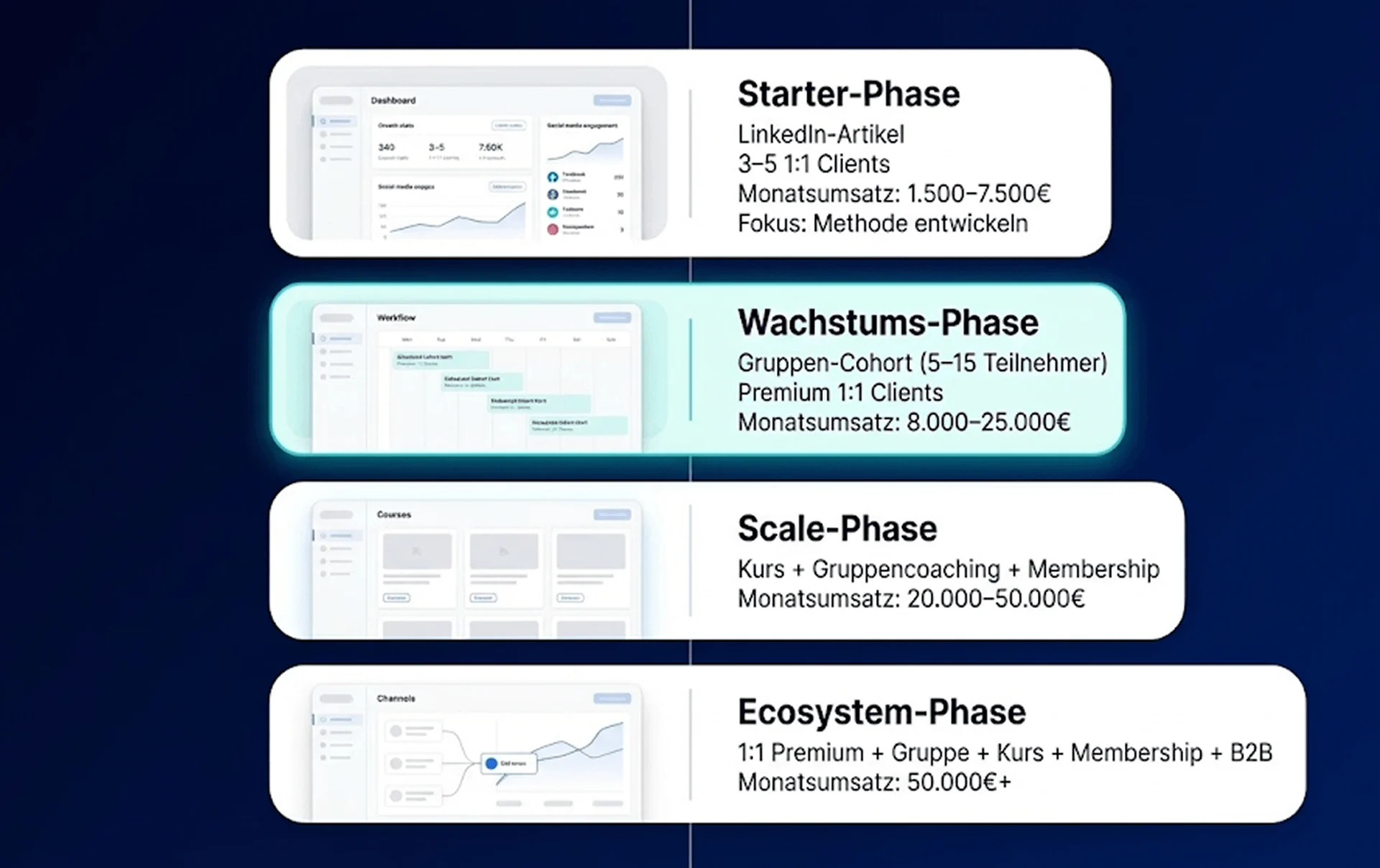
The revenue ceiling for pure one-on-one coaching ranges from €3,000 to €8,000 per month. Without a change in approach, that’s as far as you’ll go—there simply aren’t enough hours in the day. Scaling doesn’t require compromising on quality; it requires a structural shift in thinking.
When is the right time to make the switch?
Too soon (common mistake): Launching your first group coaching cohort before you’ve had 5–10 successful one-on-one clients. The result: an unrefined method, weak testimonials, and a lack of insight into client patterns.
That's right: Only after you've successfully guided at least 5–10 one-on-one clients through your program will you know: what the typical obstacles are, where your method works and where it doesn't, which questions come up time and again, and how you can make your results reproducible.
This knowledge is the foundation of your group coaching—and without it, there is no systematic structure.
The Most Common Scaling Mistakes — and How to Avoid Them
In her market analysis, Katharina Nahm has identified the five most common mistakes made by new coaches in the DACH region:
Mistake 1: No clear, scalable offer An offer must include: a specific target audience, a concrete problem, a measurable result, a price, and a timeline. Without these five components, marketing is impossible.
Mistake 2: Instagram Only, No Email Marketing Instagram reach is fleeting. 32% of creators report declining reach. An email list of 500 genuine subscribers is more valuable in the long run than 5,000 Instagram followers.
Mistake 3: Fear of selling, lack of a structured sales system Selling isn’t pushy if the offer provides real value. If you never actively make an offer out of fear of rejection, you leave potential clients without the help they’re looking for.
Mistake 4: Lack of consistency instead of systems The first month often goes well—then the energy starts to wane. A sustainable business needs systems and processes, not constant motivation.
Mistake 5: The Lone Warrior Syndrome Coaches who invest in other coaches (through mentoring or mastermind groups) have been shown to grow faster. It’s the irony of the coaching market: the very product that coaches sell to others—guidance, accountability, and a fresh perspective—is something many fail to apply to themselves.
The Scaling Roadmap by the Numbers
If you don't have a course topic or a clear niche yet: Finding an online course topic: How to identify a profitable niche
Your Content Strategy as a Coach: Visibility Without the Hamster Wheel
Publishing content isn’t optional when you’re building a coaching business—but it doesn’t have to become a full-time job. 58% of top creators use social media as their primary traffic channel, but according to Circle 2026, 32% also report declining, unreliable reach. The system that works in the long run doesn’t rely on social media algorithms—it builds an owned asset.
The Minimum Viable Content System
This system works for coaches who don't want to produce content every day but still want to build their visibility:
Choose a primary platform: LinkedIn or Instagram—not both at the same time. LinkedIn is the clear choice for B2B coaches and coaches working with corporate clients. Instagram is best for coaches in the consumer segment (wellness, lifestyle, fitness, career). TikTok is growing rapidly, but the audience willing to pay for high-priced programs is more prevalent on LinkedIn and Instagram.
Frequency over quality: Three posts a week over 12 months are better than one viral post a month. Consistency is the underrated secret weapon of content marketing. Someone who posts something every Thursday for 52 weeks will have built more trust by the end of the year than someone with five perfect posts and thirteen weeks of silence.
Content types with the greatest impact for coaches:
- Problem Diagnosis Posts: "5 Signs You're Currently Struggling With [Problem]" — encourages self-awareness, high comment rate
- Transformation Stories: A concrete before-and-after account of yourself or an (anonymized) client — builds credibility and emotional connection
- Contrarian arguments: "Why [common advice] is wrong" — sparks discussion and demonstrates a strong stance
- How-to Microcontent: A practical tip anyone can put into practice today — demonstrates expertise without being salesy
The email list as a foundation
Social media algorithms are out of your control. An email list is yours. According to ActiveCampaign, automated email sequences achieve 70.5% higher open rates and 152% higher click-through rates than manual campaigns—because they reach the right people at the right time.
For coaches, the simple launch formula applies: 500 email subscribers × 2% conversion rate × €1,497 program fee = €14,970 in revenue per launch. Most coaches can reach 500 genuine subscribers within 3–6 months—if you focus your efforts on it.
The Lead Magnet for Coaches: Your lead magnet is the entry point into your ecosystem—and it must, without exception, be free and valuable. The five most effective lead magnet formats for coaches in 2026:
- Mini-course (3–5 videos, 30–45 min. total): Solves a specific subproblem — ideal as hosted content in your members-only area
- Self-Assessment Quiz: "How good is your [skill] really?" — high conversion rates because self-awareness motivates
- A PDF checklist with real depth: Not just 5 superficial tips, but a genuine step-by-step process
- Webinar Recording: " [Specific Result] in 60 Minutes" — Demonstrates Expertise in Real Time, Nurtures Leads
- Free Framework Template: A Practical Tool (Notion Template, Google Sheet, Canvas) — Demonstrates Methodology, Builds Engagement
From Content to Paying Customer: The Conversion Path
Content without a conversion path is a hobby, not a business. Here’s what the simplest, most effective path for coaches looks like:
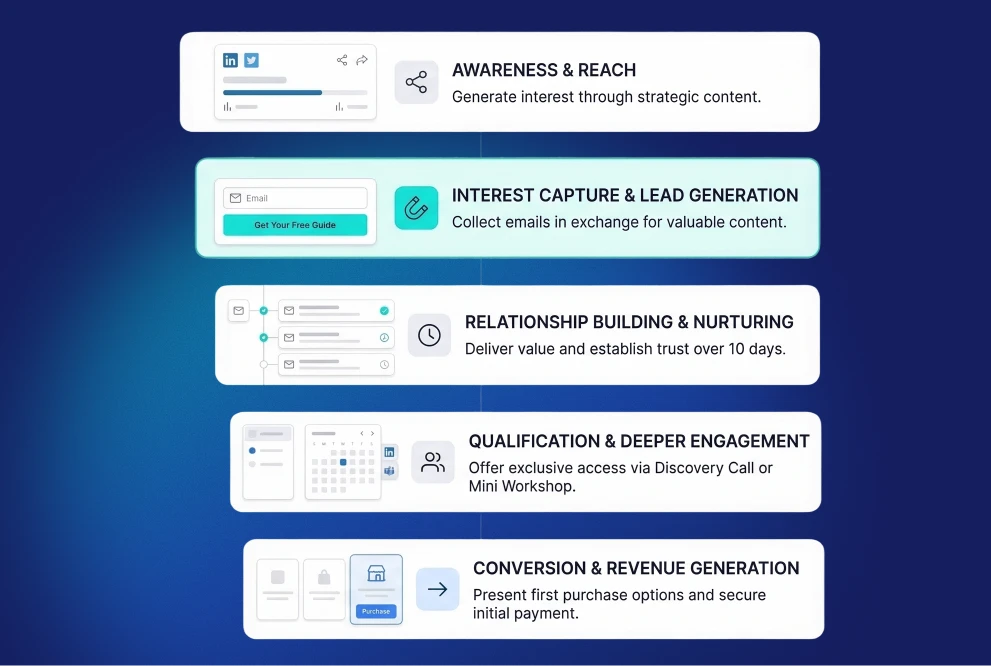
Every step along this path can be optimized—but what’s more important is that the path exists in the first place. Many coaches post regularly yet still have no clients because they don’t offer a clear next step anywhere. The conversion doesn’t happen in the content—it happens during the discovery call or in the explicit offer.
A valuable resource for your next step: Building an Email List as a Coach: The Complete Playbook
When is paid advertising worth it?
Paid ads—on Facebook, Instagram, and Google—are almost always the wrong priority when starting a coaching business. Not because advertising doesn’t work, but because it acts as an amplifier: it amplifies what’s already working. Spending money on paid ads for an offer where you don’t yet know the organic conversion rate just burns through your budget without yielding any insights.
The rule of thumb: Don’t run paid ads until you have at least 10 paying clients or course participants from organic channels and know which positioning, target audience, and landing page are driving conversions. Then you can scale that knowledge—instead of investing blindly in advertising.
The average cost per lead in the B2B SaaS and coaching sectors will be $310 in 2026 — if you don’t know what a lead is worth, you can’t build profitable campaigns.
Conclusion: A Solid Foundation for a Coaching Business
A coaching business isn’t built on a perfect website, 10,000 Instagram followers, or the most expensive course platform. It’s built on a clear system consisting of: a specific niche, a concrete value proposition, transparent pricing, a minimal and manageable tech stack, and the willingness to proactively reach out to the right people.
The Coaching Business Roadmap provides you with the structural framework. Your approach, your experience, and your clients provide the content.
The 6 key takeaways from this guide:
- A niche is the foundation—the more specific it is, the easier it is to sell and the higher the potential price
- A product ladder instead of a single offering — create multiple entry points across different price segments
- Our first customers come from our network, not from social media—direct outreach is more effective than content
- Compliance with legal requirements (ZFU, GDPR, business regulations) isn’t something you can put off until later—it’s the foundation of a sustainable business
- Don't scale up until your method has proven to deliver consistent results with 5–10 clients
- Choose a tech stack that grows with you—not one that requires data migration and a complete rebuild after six months
Want to get started right away? Try Memberspot for 14 days free —no credit card required, no risk.